
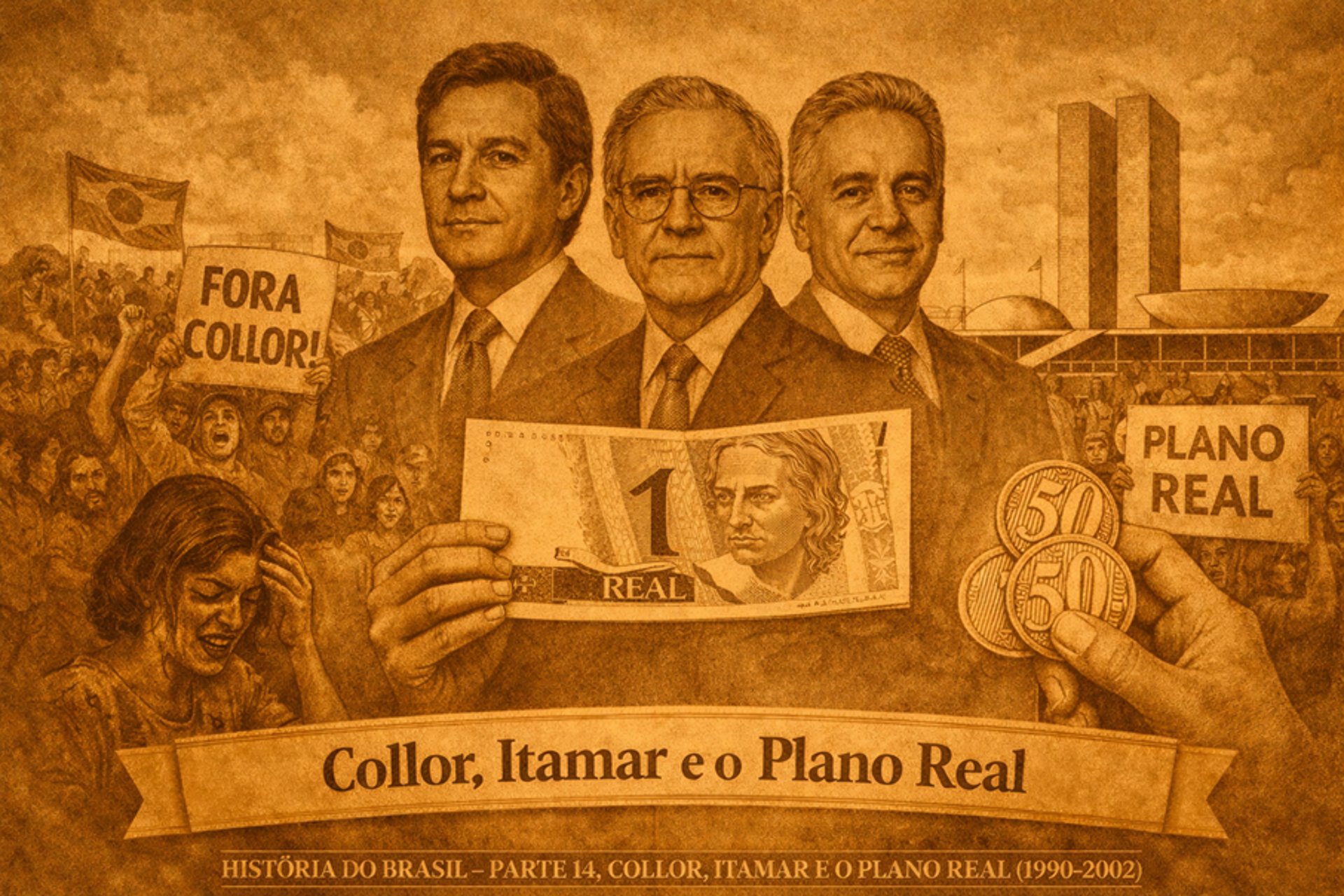
History of Brazil – Part 14: Collor, Itamar, and the Real Plan (1990–2002)
HISTÓRIAS DO BRASILNOVA POSTAGEM
Blog Toda História
4/8/2026
After the promulgation of the 1988 Constitution and the return of direct elections, Brazil entered a new phase in its history: the consolidation of democracy amid major economic challenges.
The 1989 election marked this beginning. In the runoff, Fernando Collor de Mello and Luiz Inácio Lula da Silva competed for the presidency. Collor emerged victorious and took office in 1990.
The Collor Government and the Collor Plan
Collor came to power with a discourse focused on fighting corruption and modernizing the economy. He promised to confront the so-called “marajás” — public servants with high salaries — and reduce the size of the state.
Economically, Brazil’s main problem was extremely high inflation, which completely disrupted the economy.
To try to contain inflation, the government launched the Collor Plan, a radical measure that became one of the most controversial in Brazilian history.
The plan’s main action was the freezing of bank accounts. The government temporarily confiscated a large portion of money held in checking accounts, savings accounts, and financial investments, releasing only small amounts for immediate use.
The goal was to reduce the amount of money in circulation to curb inflation. However, the measure had severe consequences:
companies lost working capital
consumption dropped sharply
many people lost access to their savings
unemployment increased
Despite the initial impact, inflation soon rose again, and the plan ultimately failed.
Political Crisis and Impeachment
In addition to economic problems, the Collor government faced serious corruption allegations involving people close to the president.
These accusations mobilized society. One of the most notable movements was the “caras-pintadas,” formed mainly by students protesting in the streets and demanding impeachment.
In 1992, Congress approved the impeachment process. Before the final vote, Collor resigned, but still had his political rights suspended.
It was the first impeachment of a president in Brazil’s republican history.
The Itamar Franco Government
After Collor’s departure, Vice President Itamar Franco assumed the presidency.
Itamar adopted a more conciliatory approach and sought to stabilize the country both politically and economically. His administration became marked by one of the most important decisions in Brazil’s recent history: the creation of the Real Plan.
The Real Plan and the End of Hyperinflation
To tackle inflation, Itamar appointed sociologist Fernando Henrique Cardoso as Minister of Finance.
The Ministry of Finance is responsible for the country’s economic policy, including public spending, revenue collection, and financial stability.
Under his leadership, the Real Plan was developed and implemented in 1994.
Unlike previous plans, the Real Plan was structured in stages:
1. Control of Public Spending
The government sought to balance public accounts:
spending cuts
tighter control over money issuance
reduction of deficits
2. Creation of the URV (Unit of Real Value)
The URV was a transitional currency, created to stabilize prices amid high inflation.
In practice:
prices were displayed in URV
payments were still made in the old currency
it helped prepare the economy for the new currency
3. Creation of the Real
On July 1, 1994, the new currency was introduced: the real (R$), replacing the cruzeiro real.
The new currency brought stability and ended the cycle of hyperinflation.
The strategy worked. Inflation dropped rapidly, and the economy began to stabilize.
The Real Plan became a milestone in Brazil’s economic history, as it brought predictability and enabled financial planning for both families and businesses.
The Fernando Henrique Cardoso (FHC) Government
The success of the Real Plan boosted the election of Fernando Henrique Cardoso to the presidency in 1994.
Important:
President Itamar Franco did not run for re-election. Fernando Henrique, as Minister of Finance responsible for the Real Plan, gained popularity and was elected.
He was re-elected in 1998, governing from 1995 to 2002.
His administration continued economic stabilization and implemented structural reforms.
Main characteristics of the period:
inflation control
→ maintenance of the Real Planprivatizations
→ sale of companies such as Vale do Rio Doce and the Telebrás systemeconomic openness
→ greater integration into the global marketstrengthening of the financial system
→ stricter banking regulationsearly social programs
→ Bolsa Escola and Auxílio Gás
Privatizations aimed to reduce government spending and increase economic efficiency.
Challenges of the period:
international crises (Asia and Russia)
increase in public debt
unemployment in some sectors
criticism of privatizations
Brazil at the Beginning of the 21st Century
By the end of the FHC administration, Brazil had a more stable economy compared to previous decades. Inflation was under control, and the country was more integrated into the global economy.
However, structural problems remained:
high social inequality
income concentration
challenges in education and healthcare
external economic dependence
The Meaning of the Period (1990–2002)
The period between 1990 and 2002 was crucial for consolidating Brazilian democracy and establishing more stable economic foundations.
It marked the end of hyperinflation and the beginning of a new phase in Brazil’s economy.
At the same time, it opened the door to new debates about development, social inclusion, and the role of the state — issues that would remain central in 21st-century Brazil.
Read more:
Email:
Give your Feedback:
contato.todahistoria@gmail.com
© 2025-2026 Todo História - All rights reserved.
This website may contain affiliate links.
By submitting the form, you represent that you agree to the Terms of Use and the Privacy Policy. The content of this message is not shared with Brevo.