
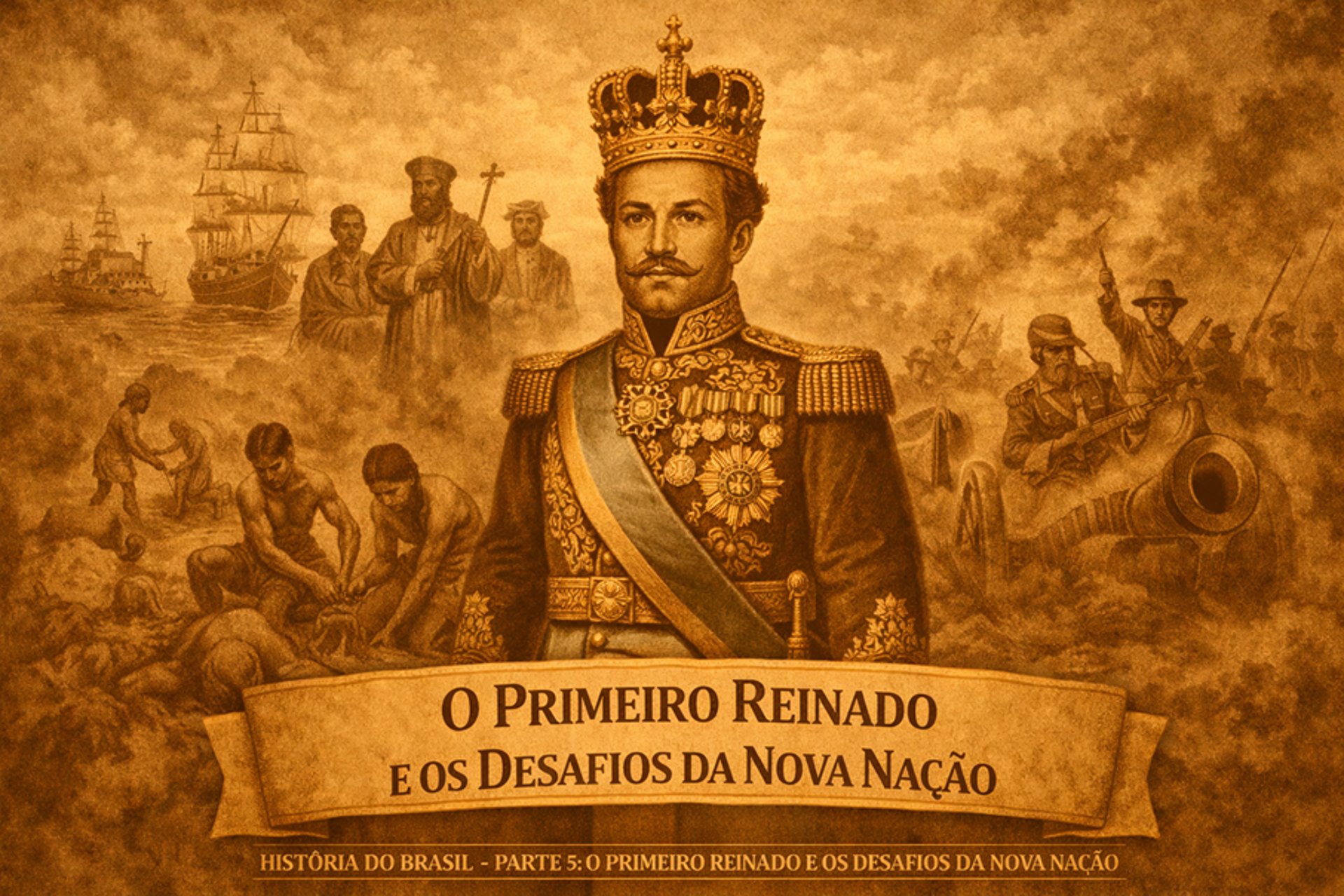
History of Brazil – Part 5: The First Reign and the Challenges of a New Nation (1822–1831)
HISTÓRIAS DO BRASIL
Blog Toda História
1/22/2026
The Birth of the Brazilian Empire
With the proclamation of Independence on September 7, 1822, Brazil officially ceased to be a Portuguese colony and began to exist as a sovereign state. Shortly thereafter, Dom Pedro was crowned Dom Pedro I, Emperor of Brazil, inaugurating the period known as the First Reign.
However, independence did not bring immediate stability. The new country faced enormous political, economic, and social challenges inherited from more than three centuries of colonial rule.
Colonial Legacies and Early Challenges
Brazil was born independent but deeply marked by its colonial past. The economy remained based on monoculture, the export of primary goods, and enslaved labor. Most of the population was excluded from political life, while power remained concentrated in the hands of agrarian and commercial elites.
One of the first obstacles faced by the new government was obtaining international recognition of independence. Portugal officially recognized Brazil only in 1825, after lengthy negotiations and the payment of an indemnity financed by England. This agreement generated significant foreign debt, placing the country in a delicate economic situation at the very beginning of its trajectory as an independent nation.
Political Disputes and the Constitution of 1824
In the political arena, intense disagreements emerged over the form of government. Liberals advocated greater provincial autonomy, decentralization of power, and broader political participation. Conservatives, on the other hand, supported a strong and centralized government in the hands of the emperor, fearing the fragmentation of national territory.
These tensions led to the convening of a Constituent Assembly in 1823, tasked with drafting Brazil’s first Constitution. When Dom Pedro I realized that the deputies sought to limit his powers, he forcibly dissolved the Assembly in an episode known as the Night of Agony.
In 1824, the Constitution of the Empire was granted, drafted by jurists aligned with the emperor. The document established Brazil as a constitutional monarchy, but with a unique feature: the creation of the Moderating Power, exclusive to the emperor. This authority allowed him to interfere in the other branches—Executive, Legislative, and Judiciary—making him the central figure of the political system.
Although it guaranteed certain individual liberties, such as the right to property and limited religious freedom, the Constitution restricted voting rights to a small portion of the population based on income criteria. Enslaved people, women, Indigenous peoples, and most poor men were excluded from political participation.
Internal Revolts and the Confederation of the Equator
The strong centralization of power generated discontent in several regions. In 1824, the Confederation of the Equator erupted, a movement led by liberal and republican sectors in the Northeast, especially in Pernambuco. The rebels defended the creation of an independent republic and greater regional autonomy.
The imperial government violently repressed the movement, resulting in arrests, executions, and the strengthening of Dom Pedro I’s authoritarian image.
External Conflicts and Political Crisis
On the international front, Brazil became involved in the Cisplatine War (1825–1828) against the United Provinces of the Río de la Plata (present-day Argentina). The dispute over the Cisplatine region—now Uruguay—consumed financial resources, worsened the economic crisis, and increased popular discontent. At the end of the conflict, Brazil recognized Uruguay’s independence, which was interpreted as a political and military defeat.
At the same time, the economy struggled, inflation rose, and the imperial government lost support among various social groups. The Brazilian elite increasingly viewed Dom Pedro I as excessively aligned with Portuguese interests.
The Final Crisis and Abdication
The situation worsened further after the death of Dom João VI in 1826. Dom Pedro I became heir to the Portuguese throne, raising fears of a possible reunification or loss of Brazilian autonomy. His attempts to reconcile the interests of Portugal and Brazil intensified internal distrust.
Opposition grew, newspapers openly criticized the emperor, protests spread through the streets, and conflicts between Brazilians and Portuguese became frequent. One of the most symbolic episodes of this tense climate was the Night of the Bottle Fights (Noite das Garrafadas) in 1831, marked by violent clashes in the streets of Rio de Janeiro.
Faced with the loss of political support, popular pressure, and growing instability, Dom Pedro I made a historic decision. On April 7, 1831, he abdicated the Brazilian throne in favor of his son, Dom Pedro de Alcântara, who was only five years old at the time. He then returned to Europe, where he became involved in political conflicts in Portugal.
The End of the First Reign and Its Legacy
The abdication marked the end of the First Reign and the beginning of a new and unstable phase: the Regency Period. Brazil came to be governed by regents, facing regional revolts, political disputes, and the challenge of maintaining the unity of a young, vast, and deeply unequal country.
Although short-lived, the First Reign was decisive for consolidating independence and defining the political foundations of the Brazilian state. It revealed the difficulties of transforming a colony into a sovereign nation and showed that independence was only the beginning of a long and complex process of national construction.
For further reading, most recommended works on Brazilian history are available in Portuguese.
Read more:
Email:
Give your Feedback:
contato.todahistoria@gmail.com
© 2025-2026 Todo História - All rights reserved.
This website may contain affiliate links.
By submitting the form, you represent that you agree to the Terms of Use and the Privacy Policy. The content of this message is not shared with Brevo.