
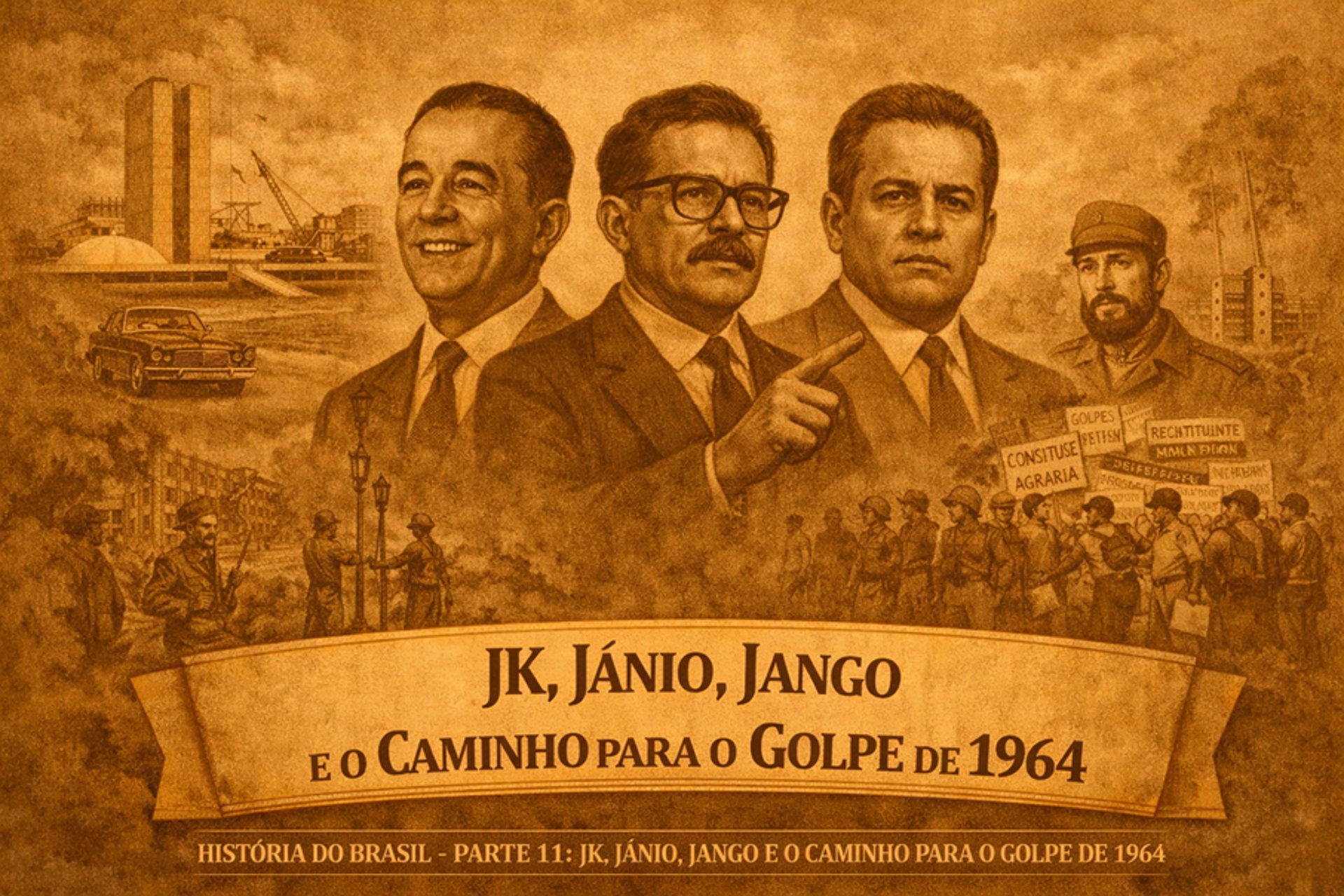
History of Brazil – Part 11: JK, Jânio, Jango and the Road to the 1964 Coup (1956–1964)
HISTÓRIAS DO BRASIL
Blog Toda História
3/3/2026
After the death of Getúlio Vargas in 1954, Brazil plunged into a period of political instability that revealed deep tensions between competing national projects. The 1955 elections brought Juscelino Kubitschek to power, inaugurating a phase of accelerated growth and structural transformation.
The JK Administration and the Targets Plan (1956–1961)
JK took office in 1956 with the Targets Plan (Plano de Metas), summarized in the slogan “Fifty Years in Five.” His goal was to accelerate industrialization and modernize Brazil.
The government encouraged foreign capital — especially in the automobile industry — expanded energy infrastructure, and invested heavily in highway construction.
The greatest symbol of this project was the construction of Brasília, inaugurated in 1960. The new capital represented the interiorization of development and the image of a modern and integrated Brazil.
Economic growth was significant. However, it was financed through heavy foreign debt and monetary expansion, which led to rising inflation. The country industrialized rapidly, but social inequalities remained profound.
Jânio Quadros and the Crisis of 1961
In 1960, Jânio Quadros was elected on an anti-corruption and moralizing platform.
His government, which began in 1961, adopted an independent foreign policy, seeking dialogue with both the United States and socialist countries. This stance displeased conservative sectors and part of the Armed Forces.
In August 1961, Jânio unexpectedly resigned. His resignation triggered a serious institutional crisis, as Vice President João Goulart faced resistance from military and conservative groups.
To prevent his full assumption of power, a parliamentary system was temporarily implemented, reducing his authority. In 1963, a plebiscite restored the presidential system, granting Goulart full executive powers.
The Basic Reforms and Polarization
From that point on, the government began advocating the so-called Basic Reforms (Reformas de Base), which included:
Agrarian reform with expropriation of large unproductive estates
Banking reform
Tax reform
Educational reform
Expansion of voting rights
These proposals aimed to transform longstanding structures of income and power concentration. At the same time, they faced intense opposition from agrarian elites, business sectors, segments of the urban middle class, and conservative sectors of the Church and the Armed Forces.
The International Context and the Cold War
The international scenario intensified domestic tensions. After the Cuban Revolution, the United States adopted a more active stance in Latin America to contain governments considered close to socialism, within the broader context of the Cold War.
Declassified official documents later revealed that the U.S. government closely monitored Brazil’s political crisis. Ambassador Lincoln Gordon maintained direct communication with Washington regarding the situation.
Records indicate that financial resources were directed to opposition groups against João Goulart’s government, including political campaigns and anti-communist mobilizations. Civil institutions and business sectors received indirect support through channels linked to U.S. foreign policy.
In the days leading up to the coup, Operation Brother Sam was prepared — a logistical plan that provided for the shipment of fuel, ammunition, and naval support to the Brazilian coast in case of armed resistance to the military movement. The operation demonstrates that there was concrete willingness to support Goulart’s removal.
The Final Crisis and the 1964 Coup
Domestically, large opposition demonstrations were organized, such as the March of the Family with God for Freedom. At the same time, unions and popular movements mobilized in defense of the reforms.
The country was deeply polarized. On one side were groups defending structural reforms. On the other were sectors that interpreted these proposals as a threat to social order and to Brazil’s alignment with the Western bloc.
On March 31, 1964, military troops moved against the government. On April 1, João Goulart left Brasília. Without significant military resistance, power was assumed by the Armed Forces.
The episode became known as the 1964 Brazilian coup d'état. For its supporters, it was a “preventive revolution.” For its opponents and for contemporary historiography, it was the overthrow of a constitutional president and the beginning of an authoritarian regime.
The coup marked the end of the democratic experience that had begun in 1945 and initiated 21 years of military dictatorship in Brazil.
The Meaning of the Period (1956–1964)
The years between 1956 and 1964 were marked by accelerated modernization, growing social mobilization, ideological polarization, and geopolitical interference within the context of the Cold War.
The tensions accumulated during this period resulted in an institutional rupture that would profoundly shape Brazil in the decades that followed.
Read more:
Email:
Give your Feedback:
contato.todahistoria@gmail.com
© 2025-2026 Todo História - All rights reserved.
This website may contain affiliate links.
By submitting the form, you represent that you agree to the Terms of Use and the Privacy Policy. The content of this message is not shared with Brevo.