
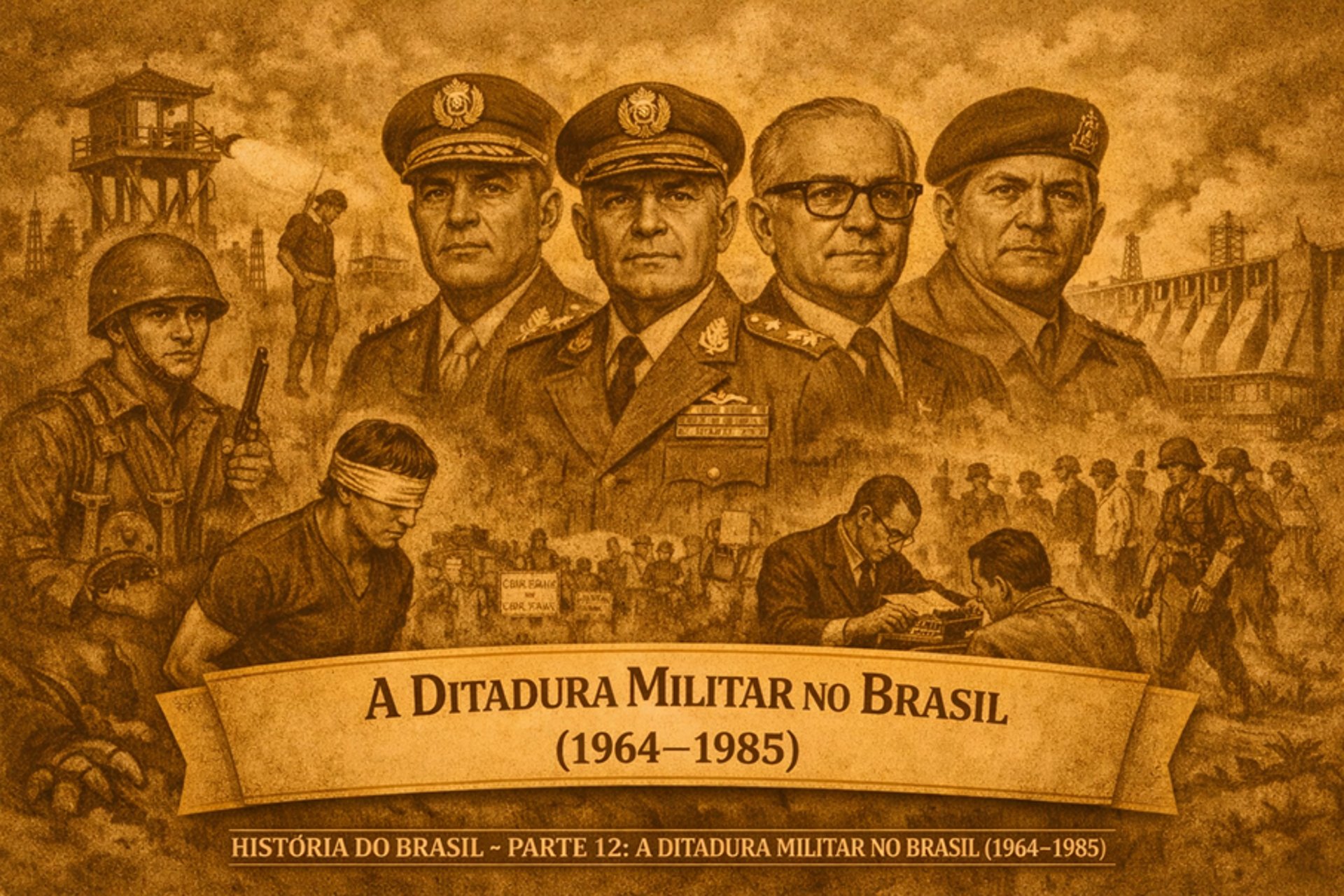
History of Brazil – Part 12: The Military Dictatorship in Brazil (1964–1985)
HISTÓRIAS DO BRASIL
Blog Toda História
3/13/2026
After the 1964 Coup, Brazil entered a period of military rule that would last 21 years. The regime was established under the argument of containing the advance of communism and restoring the country’s political and economic order. In practice, this period was marked by the concentration of power in the Armed Forces, the suspension of democratic rights, and the repression of government opponents.
Soon after taking control of the country, the military formally maintained some democratic institutions, such as the National Congress, but created legal mechanisms that allowed them to govern above the Constitution. These mechanisms became known as Institutional Acts.
The first of them, Institutional Act No. 1, allowed the revocation of political mandates, the suspension of rights, and the dismissal of public employees considered opposed to the new regime. Hundreds of politicians, professors, military officers, and civil servants were removed from their positions.
Power came to be exercised by military presidents chosen indirectly. The first was Humberto de Alencar Castelo Branco, who began the institutional reorganization of the regime.
The Two-Party System: ARENA and MDB
In 1965, the military regime decided to abolish all existing political parties. In their place, a controlled system was created with only two permitted parties, in an attempt to maintain the appearance of a functioning democracy while real power remained in the hands of the military.
The party that supported the government was the National Renewal Alliance (ARENA). ARENA brought together politicians favorable to the military regime and served as the government’s support base in Congress. Most governors and parliamentarians aligned with the regime were members of this party.
On the other side was the Brazilian Democratic Movement (MDB), which functioned as a tolerated opposition within the regime. The MDB could participate in elections and criticize some government decisions, but within limits imposed by the political system controlled by the military.
In practice, this two-party system allowed the government to maintain control over national politics while preserving the appearance of a democratic system.
The 1967 Constitution
In the following years, the military government expanded its control over society. In 1967, a new Constitution was enacted that incorporated the Institutional Acts into the country’s legal system.
This Constitution strengthened the power of the Executive branch, reduced political freedoms, and consolidated the authoritarian model of the regime.
Even with these restrictions, student movements, artists, intellectuals, and various sectors of society continued to mobilize against the regime.
The Growth of Opposition and the 1968 Demonstrations
Throughout the 1960s, public demonstrations began to grow. University students organized protests in several cities across the country, denouncing the lack of political freedom.
In 1968, one of the largest demonstrations of the period took place: the March of the One Hundred Thousand, in Rio de Janeiro. The protest brought together students, artists, journalists, and various sectors of civil society in defense of democracy and against the regime’s repression.
AI-5 and the Hardening of the Dictatorship
The government’s response came in the same year with the harshest measure of the entire regime: Institutional Act No. 5, decreed in December 1968.
AI-5 granted nearly absolute powers to the military government and marked the beginning of the most repressive phase of the dictatorship.
Among its main measures were:
the closing of the National Congress
federal intervention in states and municipalities
prior censorship of the press, music, theater, and cinema
suspension of habeas corpus for political crimes
suspension of political rights for up to ten years
Habeas corpus is a legal instrument that protects citizens against illegal imprisonment. When habeas corpus is suspended, a person may be detained without a judge immediately reviewing whether the arrest was lawful or abusive. During the military regime, this allowed opponents to be imprisoned for long periods without trial.
This period became known as the “years of lead”, characterized by intense political repression.
The Repressive Institutions
During the years of greatest repression, the regime strengthened several security and intelligence agencies responsible for investigating and combating government opponents.
Among them were:
Department of Political and Social Order (DOPS) – a police institution created before the dictatorship but widely used by the regime to investigate and arrest political opponents.
Information Operations Detachment – Internal Defense Operations Center (DOI-CODI) – military units specialized in intelligence and political repression. These centers operated in the investigation, detention, and interrogation of suspected regime opponents.
Numerous reports, investigations, and later commissions documented cases of torture and abuse committed in these centers against political prisoners.
Resistance to the Regime
Faced with repression and the lack of political freedom, some groups began organizing forms of clandestine resistance. Part of these movements defended armed struggle as a way to overthrow the dictatorship.
Their actions included:
bank robberies to finance clandestine organizations
attacks against government facilities
kidnapping foreign diplomats to negotiate the release of political prisoners
These movements were harshly suppressed by the regime’s security forces.
The Military Presidents
Among the military presidents who governed the country during this period were:
Artur da Costa e Silva
Emílio Garrastazu Médici
Ernesto Geisel
João Figueiredo
The “Brazilian Economic Miracle”
During Médici’s government, the so-called Brazilian Economic Miracle occurred, between the late 1960s and the early 1970s.
During this period, Brazil recorded high rates of economic growth, driven by state investments, industrial expansion, and major infrastructure projects.
Projects built during this period included:
the Trans-Amazonian Highway
the Rio–Niterói Bridge
large hydroelectric plants
expansion of heavy industry
Despite economic growth, income became concentrated among the wealthiest sectors of the population. Social inequality increased significantly.
The Economic Crisis of the 1970s
From the 1970s onward, international crises — especially the rise in oil prices — affected the Brazilian economy.
Since the previous growth had been financed by external loans, the country began facing increasing foreign debt, high inflation, and economic slowdown.
Political Opening
Faced with the economic crisis and growing social pressure, the government of General Ernesto Geisel initiated a gradual process of political opening known as “slow, gradual, and secure détente.”
The goal was to gradually reduce the regime’s authoritarianism without losing control over the political transition.
The ABC Paulista Strikes
In the late 1970s, important workers’ strikes emerged in the industrial region known as ABC Paulista.
ABC Paulista is composed of three cities in the metropolitan region of São Paulo:
Santo André
São Bernardo do Campo
São Caetano do Sul
This region concentrated a large number of automobile and metalworking factories. The strikes organized by workers in these industries marked the resurgence of the labor movement in Brazil and had a major political impact.
The Amnesty Law
During the government of João Figueiredo, the political opening advanced.
In 1979, the Amnesty Law was approved, allowing political exiles to return to Brazil and freeing several prisoners accused of political crimes.
At the same time, the law also granted amnesty to state agents accused of abuses committed during the regime, which generated debates that continue to this day.
The Diretas Já Movement
In the 1980s, popular pressure for direct elections grew rapidly.
The Diretas Já movement, in 1984, mobilized millions of Brazilians in large public demonstrations demanding the right to directly elect the President of the Republic.
Despite the massive popular mobilization, the proposal for direct elections was rejected in Congress at that time.
The End of the Military Regime
In 1985, an indirect election brought Tancredo Neves to the presidency, marking the end of the military cycle in power.
Tancredo died before taking office, and Vice President José Sarney became president.
Thus, the military dictatorship in Brazil officially came to an end.
The period between 1964 and 1985 left deep marks on Brazilian society. In addition to economic and institutional changes, the country would debate for decades issues such as historical memory, justice, and the political and social impacts of the military regime.
Read more:
Email:
Give your Feedback:
contato.todahistoria@gmail.com
© 2025-2026 Todo História - All rights reserved.
This website may contain affiliate links.
By submitting the form, you represent that you agree to the Terms of Use and the Privacy Policy. The content of this message is not shared with Brevo.