
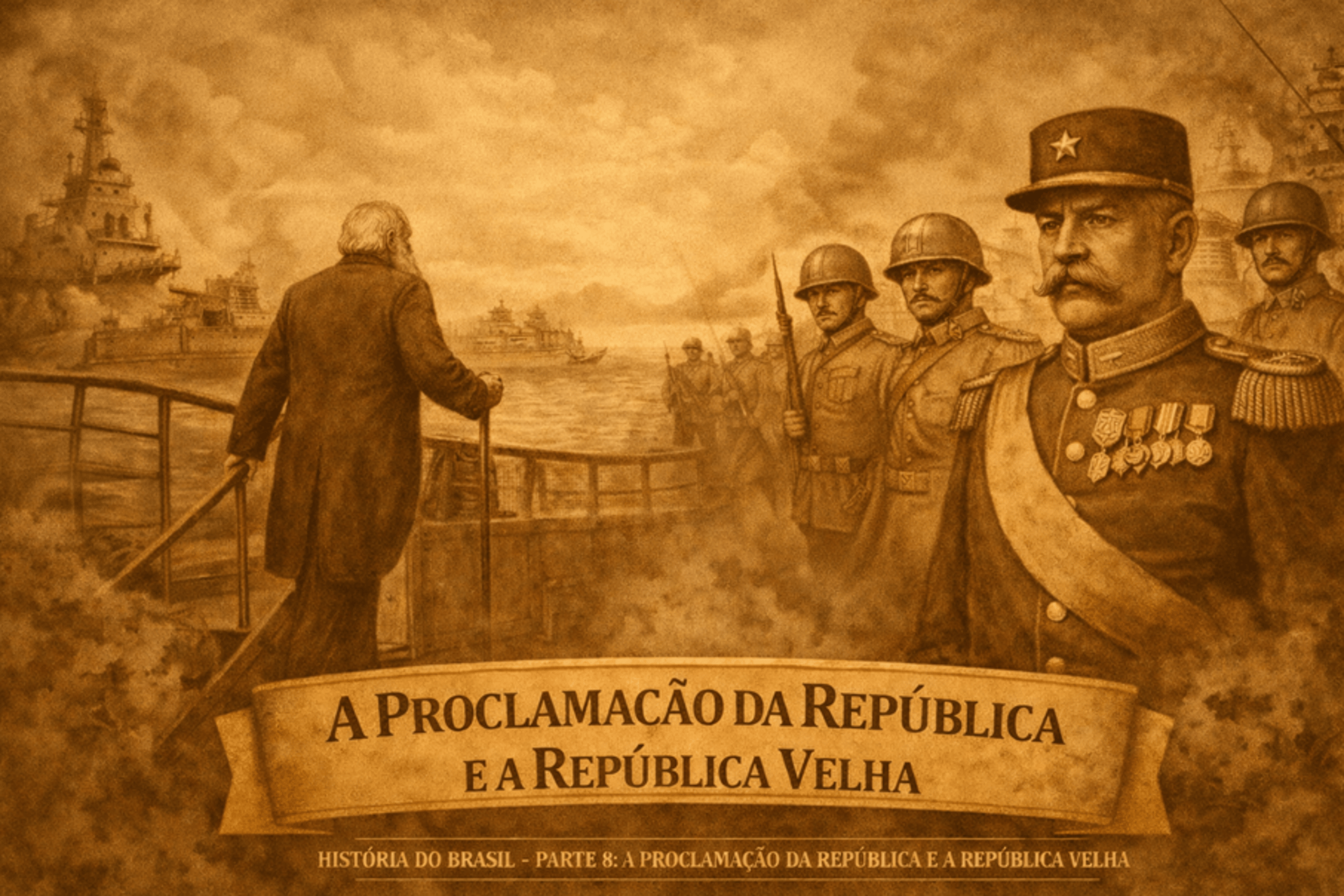
History of Brazil – Part 8: The Proclamation of the Republic and the Old Republic (1889–1930)
HISTÓRIAS DO BRASIL
Blog Toda História
2/2/2026
The Fall of the Monarchy and the Proclamation of the Republic
The end of the Second Reign represented a profound rupture in Brazil’s political history. On November 15, 1889, the monarchy was overthrown by a military coup led by Marshal Deodoro da Fonseca, ushering in the republican regime.
The change did not occur through a popular revolution. The Proclamation of the Republic resulted mainly from the dissatisfaction of political, military, and economic elites, with no direct participation from the majority of the population.
The monarchy had been weakened by several factors. The abolition of slavery in 1888 alienated large rural landowners, who received no compensation. The Army, strengthened after the Paraguayan War, felt undervalued and marginalized by the imperial government. In addition, republican and positivist ideas were gaining strength among military officers and urban intellectuals.
With the coup, Dom Pedro II was deposed and exiled along with the imperial family. A few days later, Brazil officially ceased to be a monarchy and became a federal republic, although in practice power remained concentrated in the hands of a few groups.
The Republic of the Sword (1889–1894)
Immediately after the Proclamation of the Republic, a Provisional Government was established, headed by Deodoro da Fonseca. This initial period became known as the Republic of the Sword, since the first two presidents were Army marshals: Deodoro da Fonseca and Floriano Peixoto.
Among the first measures of the new regime were the separation of Church and State, ending Catholicism as the official religion, and the adoption of new national symbols, such as the republican flag, inspired by positivism and marked by the motto “Order and Progress.”
In 1891, Brazil’s first republican Constitution was promulgated. The document established presidentialism, federalism, and direct male suffrage. However, voting was restricted to literate men, which kept most of the population excluded from political life.
Deodoro da Fonseca’s government was marked by political and economic instability. Attempts at authoritarian rule and the failure of the Encilhamento—a set of economic policies that encouraged financial speculation and generated inflation—deepened the crisis. Under pressure, Deodoro resigned later in 1891.
His successor, Floriano Peixoto, assumed the presidency amid intense tensions. Revolts such as the Naval Revolt and the Federalist Revolution in southern Brazil challenged the government. Floriano ruled in an authoritarian manner, harshly repressing opposition and consolidating the Republic by force.
The Old Republic or First Republic (1894–1930)
From 1894 onward, Brazil entered the period known as the Old Republic, which lasted until 1930. This phase was marked by the dominance of rural oligarchies, especially the elites of São Paulo and Minas Gerais.
The political system operated through coronelism. Large landowners, known as coronels, controlled local power and influenced elections through favors, intimidation, and electoral fraud. Since voting was not secret, manipulation became common practice.
At the national level, the so-called “coffee-with-milk” politics took shape—an informal alliance between the oligarchies of São Paulo, a major coffee producer, and Minas Gerais, politically influential. These states alternated in the presidency, ensuring stability for the elites while excluding most of the population from the political process.
Coffee Economy and External Dependence
During the Old Republic, the Brazilian economy remained heavily dependent on coffee exports. The government frequently intervened to protect coffee growers, purchasing and stockpiling surplus production in order to maintain prices on the international market.
This model benefited large producers but made the country vulnerable to fluctuations in the global economy, while also deepening social and regional inequalities.
Social Tensions and Popular Revolts
Despite the appearance of political stability, the Old Republic was marked by intense social tensions. Urban growth, the arrival of European immigrants, and the emergence of an urban working class increased demands for labor rights and political participation.
Several conflicts erupted during this period. One of the most emblematic was the War of Canudos (1896–1897), in the backlands of Bahia. Led by Antônio Conselheiro, the movement brought together poor rural populations and was violently suppressed by the Army, resulting in thousands of deaths.
Another significant episode was the Contestado War (1912–1916), between Paraná and Santa Catarina, involving peasants displaced from their lands by railway companies. As in Canudos, the government treated the movement as a threat to order and responded with military repression.
In the cities, revolts such as the Vaccine Revolt (1904) in Rio de Janeiro expressed popular discontent with authoritarian urban reforms and social exclusion. Once again, the State’s response was repression.
The Crisis of the Old Republic and the Road to 1930
Throughout the 1920s, the political system of the Old Republic showed clear signs of exhaustion. Young Army officers, known as tenentes, began to challenge oligarchic dominance and advocate political and social reforms. This movement became known as Tenentism.
The final crisis came with the crash of the New York Stock Exchange in 1929, which caused coffee prices to collapse on the international market. The Brazilian economy entered a severe crisis, exposing the fragility of the agro-export model.
In 1930, the political rupture was completed. Dissatisfaction with the presidential election results and the exclusion of new political forces led to the Revolution of 1930, which ended the Old Republic and brought Getúlio Vargas to power.
The Historical Significance of the Period
The Proclamation of the Republic and the Old Republic represented a change of regime, but not an immediate deep social transformation. Power remained concentrated, inequality persisted, and much of the population continued to be excluded from political decision-making.
Even so, this period was fundamental to the formation of Brazil’s modern political, economic, and social structures, laying the groundwork for the transformations that would take place from the 1930s onward.
For further reading, most recommended works on Brazilian history are available in Portuguese.
Read more:
Email:
Give your Feedback:
contato.todahistoria@gmail.com
© 2025-2026 Todo História - All rights reserved.
This website may contain affiliate links.
By submitting the form, you represent that you agree to the Terms of Use and the Privacy Policy. The content of this message is not shared with Brevo.