
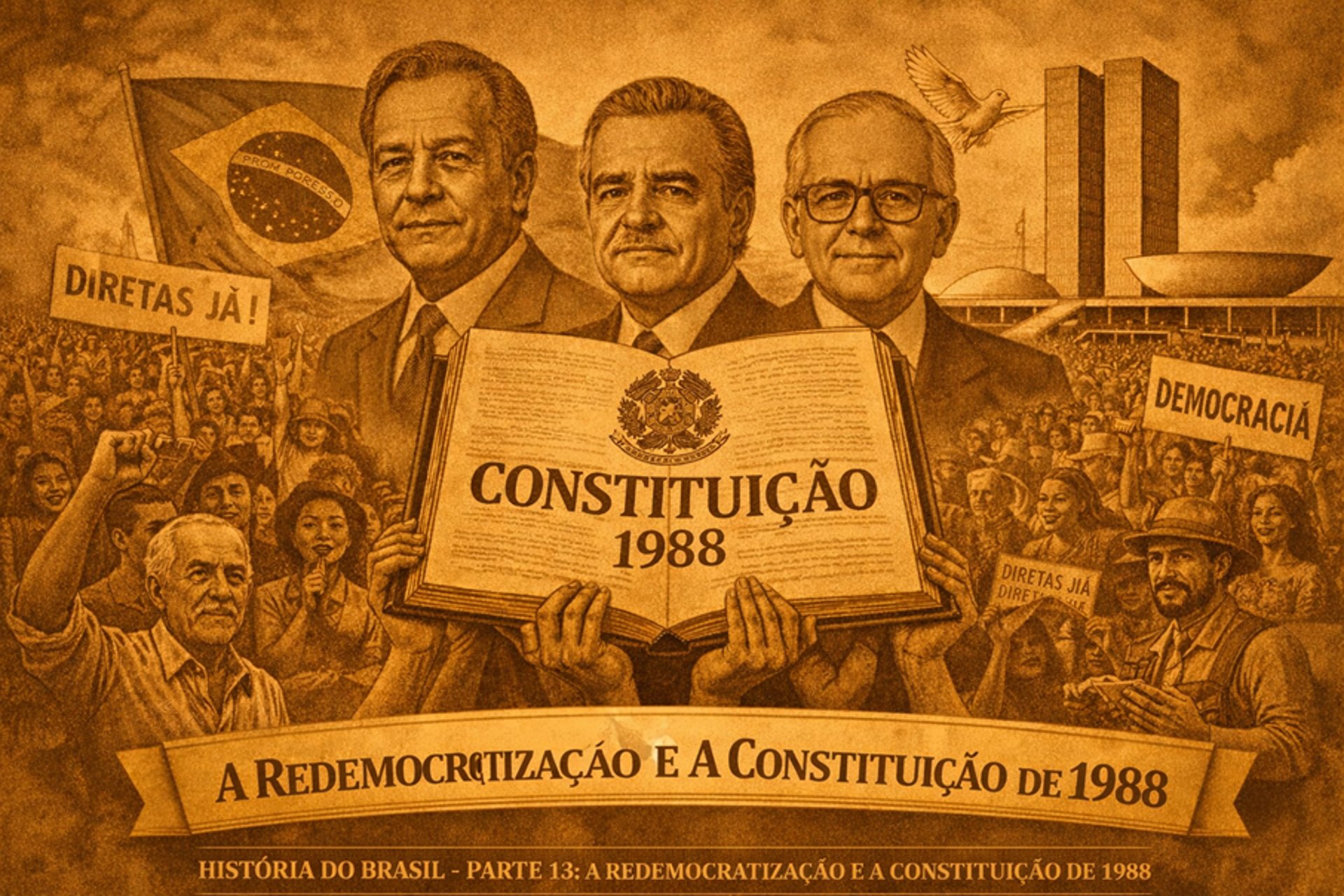
History of Brazil – Part 13: Redemocratization and the 1988 Constitution (1985–1989)
HISTÓRIAS DO BRASIL
Blog Toda História
3/21/2026
The End of the Military Dictatorship in Brazil marked the beginning of a new period in the country’s history: redemocratization. After more than two decades of authoritarian rule, Brazil began a process of rebuilding democratic institutions, restoring political freedoms, and reorganizing party life.
The transition to democracy occurred gradually and through negotiation between civilian and military sectors. In the indirect elections held in January 1985, Tancredo Neves was elected president, an opposition candidate supported by a broad political coalition.
Tancredo represented the hope for national reconciliation and the definitive return to democracy. However, just days before taking office, he was hospitalized due to serious health problems and eventually passed away in April 1985 without having assumed the position.
Faced with this situation, Vice President José Sarney assumed the presidency of the Republic. Sarney had previously been linked to the party that supported the military regime, but at that moment he was part of the political alliance that led the democratic transition.
Despite the initial uncertainties, the Sarney government continued the process of political opening. One of its main measures was the convening of a National Constituent Assembly, responsible for drafting a new Constitution to replace the legislation inherited from the military period.
The Constituent Assembly
In 1986, elections were held to choose the deputies and senators who would participate in the Constituent Assembly. The objective was to create a new Constitution that would establish solid democratic foundations for the country.
The Assembly began its work in 1987 and included intense participation from civil society. Social movements, labor unions, professional associations, religious organizations, and various sectors of the population submitted proposals and participated in debates about the rights that should be guaranteed in the new Constitution.
This process resulted in a Brazilian Constitution strongly marked by social rights and mechanisms of democratic participation.
The 1988 Constitution
On October 5, 1988, the new Constitution of the Federative Republic of Brazil was promulgated. It became known as the “Citizen Constitution,” an expression used by the president of the Constituent Assembly, Ulysses Guimarães, to highlight its commitment to the rights of the population.
The 1988 Constitution established several fundamental principles:
full restoration of democracy
guarantee of civil and political liberties
direct elections for president, governors, and mayors
independence among the Executive, Legislative, and Judicial branches
expansion of social rights
Among the social rights guaranteed were:
the right to public healthcare
the right to education
protection for workers
freedom of trade union organization
the right to strike
protection of Indigenous peoples
protection of the environment
One of the important milestones of the Constitution was the creation of the Sistema Único de Saúde, which established universal and free access to public healthcare in Brazil.
The new Constitution also expanded voting rights. The following became eligible voters:
citizens over 18 years old (mandatory voting)
young people aged 16 and 17 (optional voting)
citizens over 70 years old (optional voting)
These changes significantly expanded the political participation of the population.
Economic Challenges of Redemocratization
Despite political advances, Brazil faced serious economic problems during the 1980s. The country experienced a period known as the “lost decade” for the Latin American economy.
Inflation reached extremely high levels, reducing the population’s purchasing power and creating economic instability.
During the government of José Sarney, several economic plans were launched in an attempt to control inflation. Among them were:
Cruzado Plan – launched in 1986, it froze prices and wages and created a new currency, the Cruzado, in an attempt to break the inflation cycle.
Bresser Plan – implemented in 1987 after the failure of the previous plan, it sought to control inflation through another price freeze and cuts in public spending.
Summer Plan – launched in 1989, it created the Cruzado Novo currency and attempted to reduce inflation through new price control measures and economic adjustments.
Despite these attempts, the plans had limited results, and inflation continued to be one of the country’s greatest economic problems at the end of the 1980s.
The Return of Direct Presidential Elections
One of the milestones of redemocratization was the return of direct elections for president of the Republic. This occurred in 1989, for the first time since 1960.
The 1989 Brazilian presidential election saw broad popular participation and several candidates competing for office. In the second round, the contest took place between Fernando Collor de Mello and Luiz Inácio Lula da Silva.
Collor won the election and assumed the presidency in 1990, becoming the first president directly elected by the people after the end of the military dictatorship.
The Meaning of Redemocratization
Brazilian redemocratization represented a decisive moment in the country’s history. The 1988 Constitution established new foundations for the functioning of political institutions and significantly expanded citizens’ rights.
Despite the economic and political challenges that would continue in the following decades, this period marked the return of democracy and popular participation in Brazil’s political life.
From that moment on, the country began facing new challenges related to economic development, the reduction of social inequalities, and the strengthening of democratic institutions.
Read more:
Email:
Give your Feedback:
contato.todahistoria@gmail.com
© 2025-2026 Todo História - All rights reserved.
This website may contain affiliate links.
By submitting the form, you represent that you agree to the Terms of Use and the Privacy Policy. The content of this message is not shared with Brevo.