
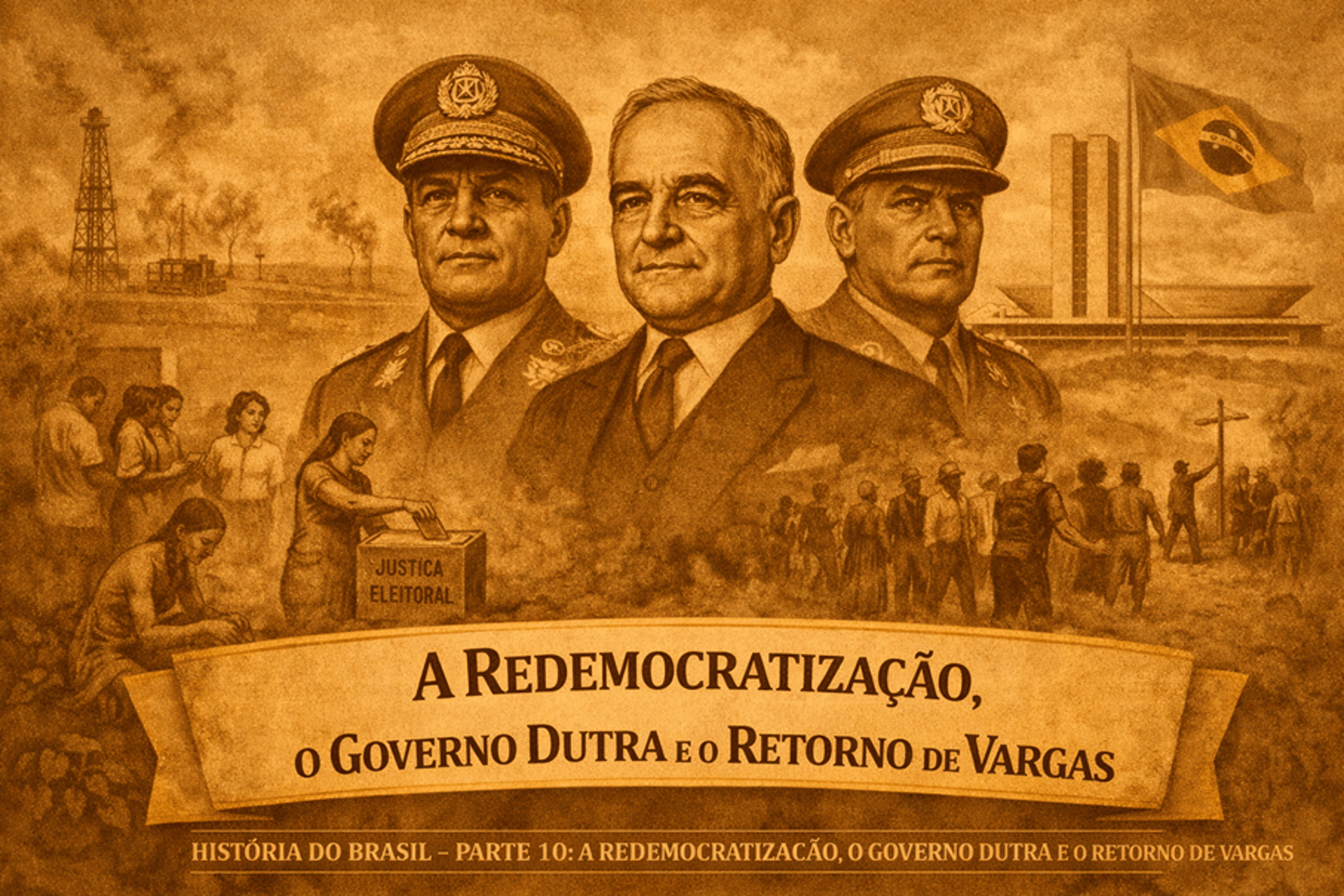
History of Brazil – Part 10: Redemocratization, the Dutra Government, and the Return of Vargas (1945–1954)
HISTÓRIAS DO BRASIL
Blog Toda História
2/13/2026
The End of the Estado Novo and the Beginning of Redemocratization
In 1945, after fifteen years in power — eight of them under the dictatorship of the Estado Novo — Getúlio Vargas was deposed by military sectors who feared his continued presence in government. Brazil was experiencing a moment of transition. World War II had ended, and the world was witnessing the strengthening of democratic regimes in the West. It had become contradictory to maintain an internal dictatorship while the country had fought against authoritarian regimes in Europe.
Popular pressure for direct elections grew. Demonstrations demanded the return of political freedoms, multiparty representation, and a new Constitution. Thus began the process of Brazilian redemocratization.
The 1945 Elections and the Government of Eurico Gaspar Dutra
Still in 1945, presidential elections and elections for a Constituent Assembly were called. General Eurico Gaspar Dutra, Vargas’s former Minister of War, won the election by direct vote.
His government represented a transitional phase: the authoritarianism of the Estado Novo came to an end, and a new constitutional period began.
In 1946, a new Constitution was promulgated. It restored civil and political rights, guaranteed freedom of the press, association, and expression, and reaffirmed the presidential system. Importantly, many labor rights created during the Vargas Era were maintained, demonstrating that they had already become embedded in the country’s social structure.
The New Party System
With redemocratization, new political parties gained prominence:
PSD (Social Democratic Party) – represented mainly regional elites and administrative sectors linked to the former government.
PTB (Brazilian Labor Party) – associated with Vargas’s labor movement and urban trade unions.
União Democrática Nacional (UDN) – brought together liberal and conservative sectors and became a strong opposition force against Vargas.
This party reorganization marked the beginning of a competitive — but deeply polarized — democracy.
The Influence of the Cold War
The international scenario came to be dominated by the Cold War, the ideological dispute between the United States and the Soviet Union. Dutra’s government aligned itself with the United States and adopted an anti-communist stance.
In 1947, the Brazilian Communist Party (PCB) was declared illegal, and its elected representatives lost their mandates. Brazil officially positioned itself within the Western bloc.
Economic Policy and the SALTE Plan
Initially, Dutra adopted a liberal economic policy, opening the market to imports. The consumption of foreign goods increased, but Brazil’s foreign currency reserves were quickly depleted.
Faced with this imbalance, the government began adopting control and planning measures. The SALTE Plan (Health, Food, Transportation, and Energy) emerged as an attempt to organize strategic investments. However, financial and administrative difficulties limited its results.
Despite the democratic regime, the period was marked by workers’ strikes, political disputes, and debates over the role of the state in the economy.
The Return of Getúlio Vargas (1951–1954)
In 1950, Getúlio Vargas once again ran for president — this time through direct elections. His candidacy mobilized workers and popular sectors who saw him as a symbol of social protection and national development.
He won the election and returned to power in 1951.
Unlike during the Estado Novo, he now governed within a democratic regime, facing intense opposition in Congress and in the press, especially from the UDN.
His second administration resumed the national-developmentalist project, advocating stronger state intervention in the economy.
The Creation of Petrobras and the National-Developmentalist Project
One of the most important milestones of Vargas’s second government was the creation of Petrobras in 1953.
Petrobras (Petróleo Brasileiro S.A.) was established as a state-owned company responsible for controlling oil exploration, production, and refining in Brazil. At that time, oil was considered a strategic resource essential for industrial development, transportation, and national economic autonomy.
Until then, Brazil depended heavily on fuel imports and on the activity of foreign companies in the energy sector. The campaign “The oil is ours” mobilized military officers, students, workers, and nationalist groups who defended the idea that Brazil’s natural resources should be exploited by the Brazilian state rather than by international corporations.
The creation of Petrobras was part of a broader project known as national-developmentalism, which advocated strong state participation in the economy to promote industrialization and reduce external dependence.
However, the proposal faced strong resistance. Opposition sectors, especially those linked to the UDN, argued that the state should not monopolize oil exploration. Business groups, liberal sectors, and foreign interests also criticized the measure, claiming it would discourage international investment and excessively expand state intervention in the economy.
The Proposal of Eletrobras
Within this same project, Vargas proposed the creation of Eletrobras, a state-owned company aimed at organizing and expanding electricity generation and distribution across the country.
In the 1950s, Brazil faced serious energy infrastructure problems. Electricity production was insufficient to sustain industrial growth. Many companies in the sector were foreign or private, and there was no efficient national coordination.
Eletrobras was intended to centralize energy planning, expand electricity production, and ensure that energy was treated as a strategic sector for national development.
Like Petrobras, the Eletrobras project faced strong opposition in Congress. Critics argued that the proposal represented excessive state control of the economy. Political resistance was so intense that the project was delayed, and Eletrobras would only be created years later, in 1962.
Political and Economic Crisis
The government faced rising inflation, social tensions, and accusations of corruption. Strikes and disputes between business leaders and workers intensified instability.
The crisis reached its peak in 1954 after the attempted assassination of journalist and opposition leader Carlos Lacerda. Investigations indicated the involvement of members of the president’s personal guard, generating enormous political pressure.
Military sectors began demanding Vargas’s resignation.
The Outcome of 1954
In the early hours of August 24, 1954, amid political crisis and the imminent threat of removal from office, Getúlio Vargas took his own life at the Palácio do Catete.
Before his death, he left the famous Carta-Testamento, a document that caused profound national commotion. Crowds took to the streets, and his death temporarily altered the political landscape.
His final act consolidated his image as one of the most striking and controversial figures in Brazilian history.
The Meaning of the Period (1945–1954)
The redemocratization that began in 1945 consolidated important democratic institutions but also revealed the intensity of ideological and social disputes in postwar Brazil.
Amid constitutional advances, political polarization, and the strengthening of the developmentalist model, the country was moving toward a new phase of instability that would culminate, years later, in another institutional rupture.
Brazilian history continued to be marked by cycles of democracy, crisis, and transformation.
Testament Letter
Getúlio Vargas
Once again, the forces and interests against the people have coordinated themselves and once again they are unleashed upon me. They do not accuse me — they insult me; they do not confront me — they slander me, and they do not grant me the right of defense. They need to silence my voice and prevent my actions so that I may not continue to defend, as I have always defended, the people — especially the humble.
I follow the destiny imposed upon me. After decades of domination and exploitation by international economic and financial groups, I became the leader of a revolution and I prevailed. I began the work of liberation and established a regime of social freedom. I was forced to resign. I returned to government in the arms of the people. The underground campaign of international groups allied itself with national groups angered by the labor protection system.
The extraordinary profits law was blocked in Congress. Hatred was unleashed against the just revision of the minimum wage. I sought to create national independence by strengthening our natural resources through Petrobras, and no sooner had it begun operating than a wave of agitation intensified. Eletrobras was obstructed to the point of desperation. They do not want workers to be free.
They do not want the people to be independent. I assumed the government amid an inflationary spiral that was destroying the value of labor. The profits of foreign companies reached as much as 500% per year. In the declared values of our imports, frauds exceeding 100 million dollars per year were uncovered. Then came the coffee crisis — our main product appreciated in value. We tried to defend its price, and the response was violent pressure upon our economy, to the point that we were forced to yield.
I have fought month by month, day by day, hour by hour, resisting constant and relentless pressure, enduring everything in silence, forgetting everything, renouncing myself in order to defend the people, who now find themselves helpless. I can give you nothing more except my blood.
If the birds of prey want someone’s blood, if they want to continue draining the Brazilian people, I offer my life as a sacrifice. I choose this way of remaining forever with you.
When you are humiliated, you will feel my soul suffering at your side. When hunger knocks at your door, you will feel in your hearts the energy to fight for yourselves and your children. When you are insulted, you will feel in your thoughts the strength to react.
My sacrifice will keep you united, and my name will be your banner of struggle. Each drop of my blood will be an immortal flame in your conscience and will sustain the sacred spirit of resistance. To hatred, I respond with forgiveness.
And to those who think they have defeated me, I reply with my victory. I was a slave of the people, and today I free myself for eternal life. But that people of whom I was a slave will no longer be anyone’s slave.
My sacrifice will remain forever in your soul, and my blood will be the price of your redemption. I fought against the exploitation of Brazil. I fought against the exploitation of the people. I have fought openly and courageously. Hatred, infamy, and slander have not broken my spirit.
I gave you my life. Now I offer you my death. I fear nothing. Serenely, I take the first step on the path to eternity and leave life to enter History.
Rio de Janeiro, August 23, 1954
Getúlio Vargas
For further reading, most recommended works on Brazilian history are available in Portuguese.
Read more:
Email:
Give your Feedback:
contato.todahistoria@gmail.com
© 2025-2026 Todo História - All rights reserved.
This website may contain affiliate links.
By submitting the form, you represent that you agree to the Terms of Use and the Privacy Policy. The content of this message is not shared with Brevo.