
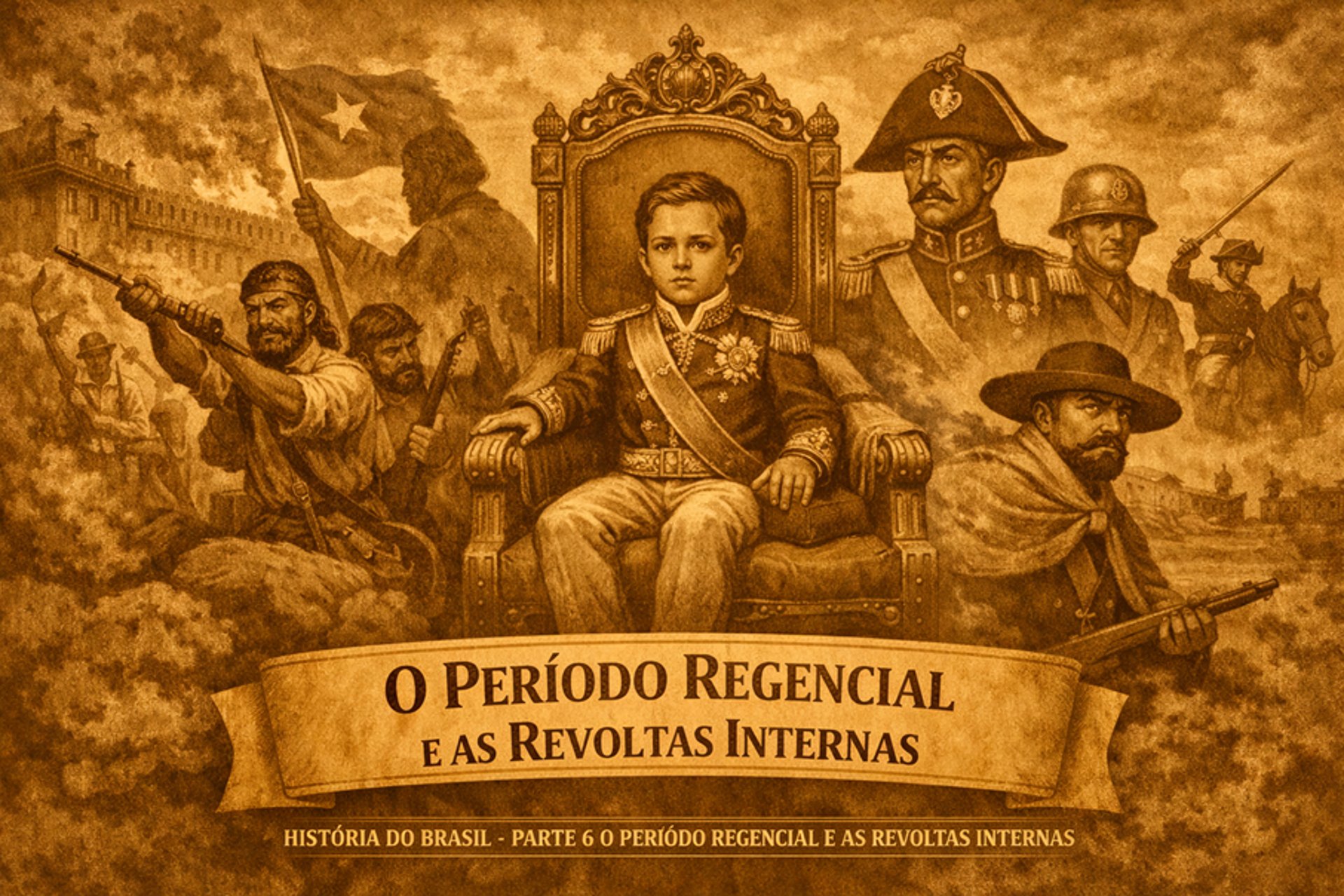
History of Brazil – Part 6: The Regency Period and Internal Revolts (1831–1840)
HISTÓRIAS DO BRASIL
Blog Toda História
1/27/2026
The Power Vacuum and the Beginning of the Regency Period
With the abdication of Dom Pedro I on April 7, 1831, Brazil entered one of the most unstable moments in its history: the Regency Period. As the heir to the throne, Dom Pedro de Alcântara, was only five years old, the country came to be governed by regents, as established by the Constitution of 1824.
The emperor’s departure created a power vacuum and exposed deep political and social divisions. Brazil was still a young, vast, and unequal country, marked by conflicting regional interests. Preserving territorial and political unity became the greatest challenge faced by the regency governments.
The Regencies and the Fragility of Central Government
Shortly after the abdication, a Provisional Trinal Regency was established, composed of three members responsible for temporarily governing the country. Soon afterward, a Permanent Trinal Regency was created, formed by representatives of the political elites.
However, the diversity of interests and the absence of strong leadership made the government fragile and inefficient. The central authority struggled to impose its power over the provinces, which increasingly demanded greater autonomy.
Political Disputes During the Regency Period
During this period, three major political groups competed for control of the state:
Moderate liberals: advocated a constitutional monarchy with some degree of administrative decentralization.
Radical liberals: supported greater provincial autonomy and, in some cases, the establishment of a republic.
Conservatives (or regressists): defended the centralization of power and the strengthening of imperial authority.
These constant disputes intensified political instability and hindered the formation of a stable government.
The Additional Act of 1834 and Attempts at Reform
Faced with political crisis, institutional reforms were proposed. In 1834, the Additional Act was enacted, amending the Constitution of 1824.
Its main measures included:
The abolition of the Trinal Regency and the creation of a Single Regency, allowing one individual to govern the country;
The granting of greater autonomy to the provinces through the creation of Provincial Legislative Assemblies.
Despite these changes, social and regional conflicts continued to intensify.
Internal Revolts and Regional Conflicts
The Regency Period is remembered as the phase with the greatest number of internal revolts in Brazilian history. Poverty, slavery, local authoritarianism, and political exclusion fueled popular uprisings across several regions.
The Cabanagem (1835–1840)
Taking place in the province of Grão-Pará, the Cabanagem involved Indigenous peoples, mixed-race populations, Black people, and poor residents known as cabanos. The movement even seized local power but was violently repressed. It is estimated that about 30% of the region’s population died during the conflict.
The Sabinada (1837–1838)
In Bahia, the Sabinada was led by sectors of the urban middle class and military officers. The rebels advocated the creation of a provisional Bahian republic until Dom Pedro II reached adulthood. The movement was harshly suppressed by the regency government.
The Balaiada (1838–1841)
In Maranhão, the Balaiada had strong popular participation, involving backlands inhabitants, cowhands, enslaved people, and small farmers. The uprising reflected deep social discontent in the region and was crushed by troops commanded by Luís Alves de Lima e Silva, the future Duke of Caxias.
The Ragamuffin War (1835–1845)
In southern Brazil, the Ragamuffin War was the longest and most organized of the regency revolts. Led by ranchers from Rio Grande do Sul, it resulted in the proclamation of the Rio-Grandense Republic. The conflict lasted ten years and ended only after negotiations and concessions by the imperial government.
Permanent Political Crisis and the Coup of the Majority
Beyond armed revolts, the period was marked by constant political crises. Alternation between liberals and conservatives in power generated administrative instability, while the central government struggled to maintain order in the provinces.
In this context, the idea of anticipating Dom Pedro II’s coming of age gained strength, despite contradicting the Constitution. Many politicians believed that the presence of an emperor would strengthen central authority and restore stability.
In 1840, with liberal support, the Coup of the Majority was proclaimed, declaring Dom Pedro II of age at just 14 years old. This officially ended the Regency Period and marked the beginning of the Second Reign.
The Legacy of the Regency Period
The Regency Period left deep marks on Brazilian history. It revealed the fragility of political institutions, the persistence of social inequalities, and the difficulty of maintaining national unity.
At the same time, it was a period of intense political experimentation, crucial for shaping the Brazilian state and preparing the country for a phase of greater stability under the rule of Dom Pedro II.
For further reading, most recommended works on Brazilian history are available in Portuguese.
Read more:
Email:
Give your Feedback:
contato.todahistoria@gmail.com
© 2025-2026 Todo História - All rights reserved.
This website may contain affiliate links.
By submitting the form, you represent that you agree to the Terms of Use and the Privacy Policy. The content of this message is not shared with Brevo.