
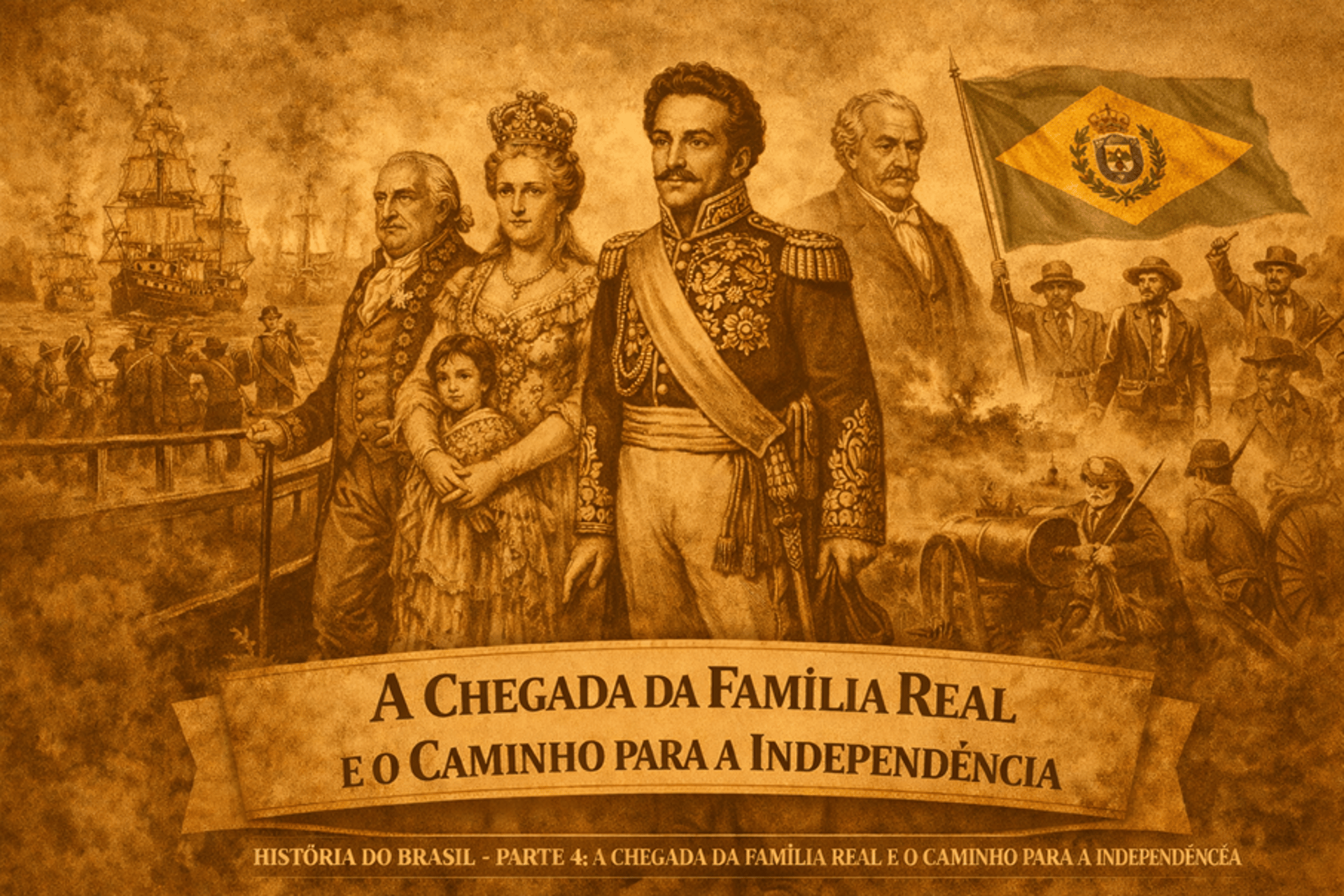
History of Brazil – Part 4: The Arrival of the Royal Family and the Path to Independence (1807-1822)
HISTÓRIAS DO BRASIL
Blog Toda História
12/26/2025
The Crisis of the Old Regime and a World in Transformation
In the late eighteenth and early nineteenth centuries, the world underwent profound political and social transformations. The Independence of the United States (1776), the French Revolution (1789), and the spread of Enlightenment ideas shook the foundations of European absolutism.
In this context of instability, the rise of Napoleon Bonaparte and his expansionist ambitions plunged Europe into successive conflicts, altering the continent’s political balance.
The Flight of the Portuguese Court to Brazil
In 1807, faced with the imminent French invasion of Portugal, the prince regent Dom João (later King Dom João VI), with the support of England, made an unprecedented decision: to transfer the entire Portuguese Court to Brazil.
For the first time in history, a colony became the seat of a European empire.
The departure took place in November 1807. Around 15,000 people—including nobles, military officers, civil servants, clergy, and servants—crossed the Atlantic carrying archives, wealth, and symbols of Portuguese power. After a difficult journey marked by storms and shortages, the fleet arrived in Salvador in January 1808 and soon after proceeded to Rio de Janeiro, which would become the new capital of the empire.
Brazil as the Center of the Portuguese Empire
The arrival of the royal family represented a turning point in Brazilian history. Until then, Brazil had been a peripheral colony, dependent on the export of primary products such as sugar, cotton, and gold.
With the presence of the court, the country gained a new political status, becoming the administrative center of the Portuguese Empire.
On January 28, 1808, Dom João decreed the Opening of the Ports to Friendly Nations, ending Portugal’s commercial monopoly. This measure allowed direct trade with other powers, especially England, which came to exert strong economic influence in Brazil.
Reforms, Institutions, and Modernization
The presence of the court accelerated profound changes in colonial life. Several fundamental institutions were created, marking the beginning of Brazil’s public and cultural life:
The Royal Press, allowing the printing of books in Brazil;
The Royal Library;
The Botanical Garden;
The Academy of Fine Arts;
Medical schools in Bahia and Rio de Janeiro.
Rio de Janeiro underwent rapid urbanization, with new buildings, paved streets, and intense cultural activity, consolidating itself as a true tropical metropolis.
The United Kingdom and the Crisis in Portugal
In 1815, Brazil was elevated to the status of the United Kingdom of Portugal, Brazil, and the Algarves, officially ceasing to be a colony. The decision sought to legitimize the court’s permanence in Rio de Janeiro but generated strong dissatisfaction in Portugal.
This discontent culminated in the Liberal Revolution of Porto (1820), which demanded the king’s return and the restoration of the former Portuguese Cortes. Under pressure, Dom João VI returned to Lisbon in 1821, leaving his son Dom Pedro as prince regent in Brazil.
Before departing, he left a piece of advice that would become famous:
“If Brazil is to separate, let it be for you, who respect me, rather than for some adventurer.”
The Day of the Fico and the Path to Independence
The Portuguese Cortes attempted to recolonize Brazil and ordered Dom Pedro’s immediate return. In response, on January 9, 1822, he declared:
“If it is for the good of all and the general happiness of the nation, tell the people that I am staying!”
The Day of the Fico symbolized the definitive break with Lisbon and marked the concrete beginning of the independence process.
In the following months, the political climate grew increasingly tense. Dom Pedro came to rely on advisers such as José Bonifácio de Andrada e Silva, a central leader of the emancipation movement.
The Proclamation of Independence
On September 7, 1822, on the banks of the Ipiranga stream in São Paulo, Dom Pedro proclaimed:
“Independence or death!”
The Empire of Brazil was officially born, with Dom Pedro crowned as its first emperor.
Limits of Independence and the Consolidation of the State
Despite the political rupture with Portugal, independence did not mean a complete break with the past. Slavery remained, agrarian elites preserved their privileges, and the social structure changed little.
Even so, September 7 marked the beginning of a new stage: the birth of a sovereign nation with its own identity and a long path of construction ahead.
In 1824, Brazil’s first Constitution was promulgated, establishing a constitutional monarchy with a strong concentration of powers in the hands of the emperor. The country would still face revolts and internal disputes, but the process of forming the Brazilian state was finally underway.
For further reading, most recommended works on Brazilian history are available in Portuguese.
Read more:
Email:
Give your Feedback:
contato.todahistoria@gmail.com
© 2025-2026 Todo História - All rights reserved.
This website may contain affiliate links.
By submitting the form, you represent that you agree to the Terms of Use and the Privacy Policy. The content of this message is not shared with Brevo.