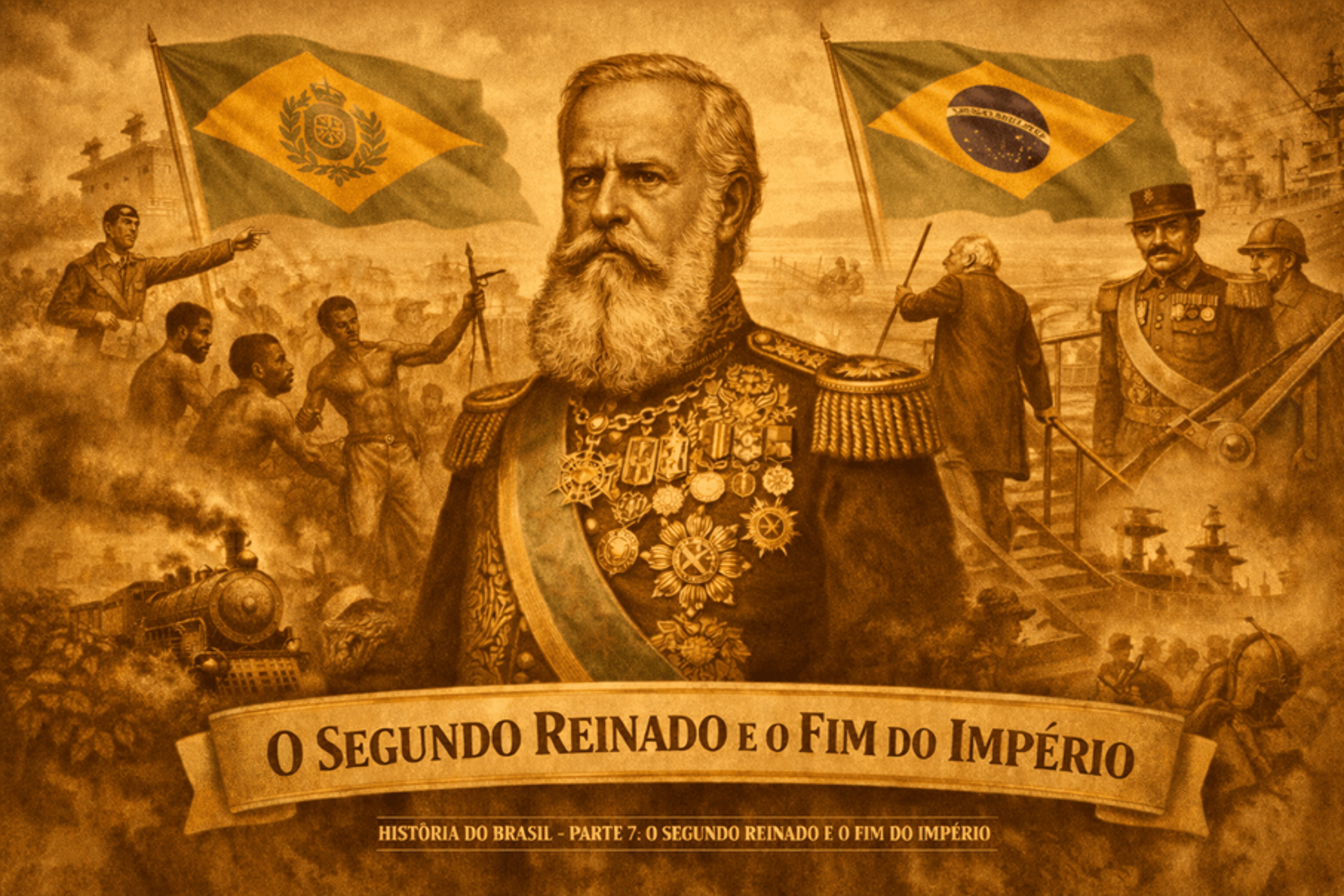
History of Brazil – Part 7: The Second Reign and the End of the Empire (1840–1889)
HISTÓRIAS DO BRASIL
Blog Toda História
1/31/2026
The Coming of Age of Dom Pedro II and the Beginning of a New Phase
With the anticipation of Dom Pedro II’s coming of age in 1840, Brazil entered a new period in its history known as the Second Reign. Unlike the turbulent Regency Period, this phase was marked by greater political stability, economic growth, and the strengthening of the institutions of the imperial state.
Dom Pedro II ascended to the throne at just 14 years of age. From an early age, he showed great interest in national affairs, gradually building the image of a cultured, moderate ruler committed to national unity. His figure became a symbol of stability in a vast and diverse territory marked by deep social inequalities.
The Political System and the “Reverse Parliamentary System”
In political terms, the Second Reign was characterized by the operation of what became known as the reverse parliamentary system. This system earned its name because, unlike classical parliamentarianism—where the head of government depends on parliamentary support—in Brazil the emperor exercised decisive control over the functioning of the government.
Through the Moderating Power (Poder Moderador), Dom Pedro II could appoint and dismiss ministers, dissolve the Chamber of Deputies, and call new elections. In practice, it was the emperor who chose the ministerial cabinet rather than Parliament, reversing the traditional logic of the parliamentary system.
Two major parties dominated imperial political life:
Liberal Party
Conservative Party
Despite their specific differences, both essentially represented the interests of the agrarian and slaveholding elites. The alternation of these parties in power became known as the policy of “rotation,” a mechanism that contributed to institutional stability and reduced the risk of prolonged political crises.
Economic Expansion and the Coffee Cycle
During the Second Reign, the Brazilian economy underwent significant transformations. Coffee became the country’s main export product, replacing sugar as the foundation of the national economy.
Initially concentrated in the Paraíba Valley, coffee production expanded into western São Paulo, a region with more fertile soils and greater growth potential. This process boosted the economy and favored the emergence of a new agrarian elite, especially in São Paulo.
The expansion of coffee stimulated major investments in infrastructure, mainly aimed at supporting export needs:
Construction of railways to transport production to ports
Opening and improvement of roads connecting producing areas to urban centers
Urban expansion and the growth of cities linked to coffee production
Together, these transformations marked a slow but steady process of modernization, particularly in the wealthier regions of southeastern Brazil.
Slavery and the Contradictions of the Empire
Despite economic prosperity, the growth of the Empire was deeply tied to the maintenance of slavery. Millions of Africans and their descendants continued to be exploited as forced labor, sustaining elite profits and the imperial economic structure.
From the mid-19th century onward, internal and external pressures began to challenge this system. Britain, Brazil’s main trading partner, pressed for the end of the transatlantic slave trade. In response, the imperial government passed the Eusébio de Queirós Law in 1850, which officially prohibited the trafficking of enslaved Africans.
Nevertheless, slavery persisted for several decades. Gradual laws were adopted as a way to postpone the definitive end of the system:
Law of Free Birth (1871): declared free the children born to enslaved women from that date onward, although these children remained under the guardianship of their mothers’ owners until adulthood.
Sexagenarian Law (1885): granted freedom to enslaved people over the age of 60, many of whom were already weakened by years of forced labor.
These measures had limited impact and did not significantly alter the reality faced by most of the enslaved Black population.
External Conflicts and the Paraguayan War
On the international stage, Brazil became involved in the Paraguayan War (1864–1870), the largest armed conflict in South American history. The war pitted Brazil, Argentina, and Uruguay against Paraguay.
The conflict imposed heavy human and financial costs but strengthened the Brazilian Army, which assumed greater political prominence after the war. During the conflict, many enslaved people were sent to the front with promises of manumission—promises that, in many cases, were indeed fulfilled.
This experience exposed deep contradictions within the imperial regime: the state relied on enslaved individuals to defend the nation while simultaneously maintaining a system that denied them citizenship. This reality contributed to the strengthening of the abolitionist movement and to growing criticism of the monarchy.
The Rise of Abolitionism and the End of Slavery
From the 1870s onward, the abolitionist movement gained momentum. Intellectuals, journalists, lawyers, students, and urban sectors began openly pressing for the end of slavery.
Mass escapes, legal actions, public campaigns, and support networks made the system increasingly unsustainable. On May 13, 1888, during Dom Pedro II’s absence due to health reasons, Princess Isabel signed the Golden Law (Lei Áurea), officially abolishing slavery in Brazil.
Despite its enormous historical significance, abolition occurred without social integration policies, leaving millions of formerly enslaved people marginalized, without access to land, decent work, or basic rights.
The Crisis of the Monarchy and the Proclamation of the Republic
The abolition of slavery deeply undermined the monarchy’s support base. Agrarian elites, dissatisfied with the loss of their primary labor force, distanced themselves from the imperial regime. At the same time, the Army—strengthened and politically active—began to question the monarchy.
Republican ideas spread among military officers and urban sectors, and the Empire came to be seen as an outdated system incapable of responding to the country’s new social and political demands.
On November 15, 1889, a military coup led by Marshal Deodoro da Fonseca proclaimed the Republic. Dom Pedro II was deposed and sent into exile, departing for Europe without armed resistance and bringing the Second Reign to a definitive end.
The Legacy of the Second Reign
The Second Reign was the longest and most stable period in the history of imperial Brazil. During this time, the country consolidated its borders, strengthened its institutions, and underwent profound economic and social transformations.
At the same time, it preserved structural inequalities that would continue to shape Brazil for decades after the fall of the monarchy, revealing the limits of a modernization project built upon social exclusion.
For further reading, most recommended works on Brazilian history are available in Portuguese.
Read more:
Email:
Give your Feedback:
contato.todahistoria@gmail.com
© 2025-2026 Todo História - All rights reserved.
This website may contain affiliate links.
By submitting the form, you represent that you agree to the Terms of Use and the Privacy Policy. The content of this message is not shared with Brevo.