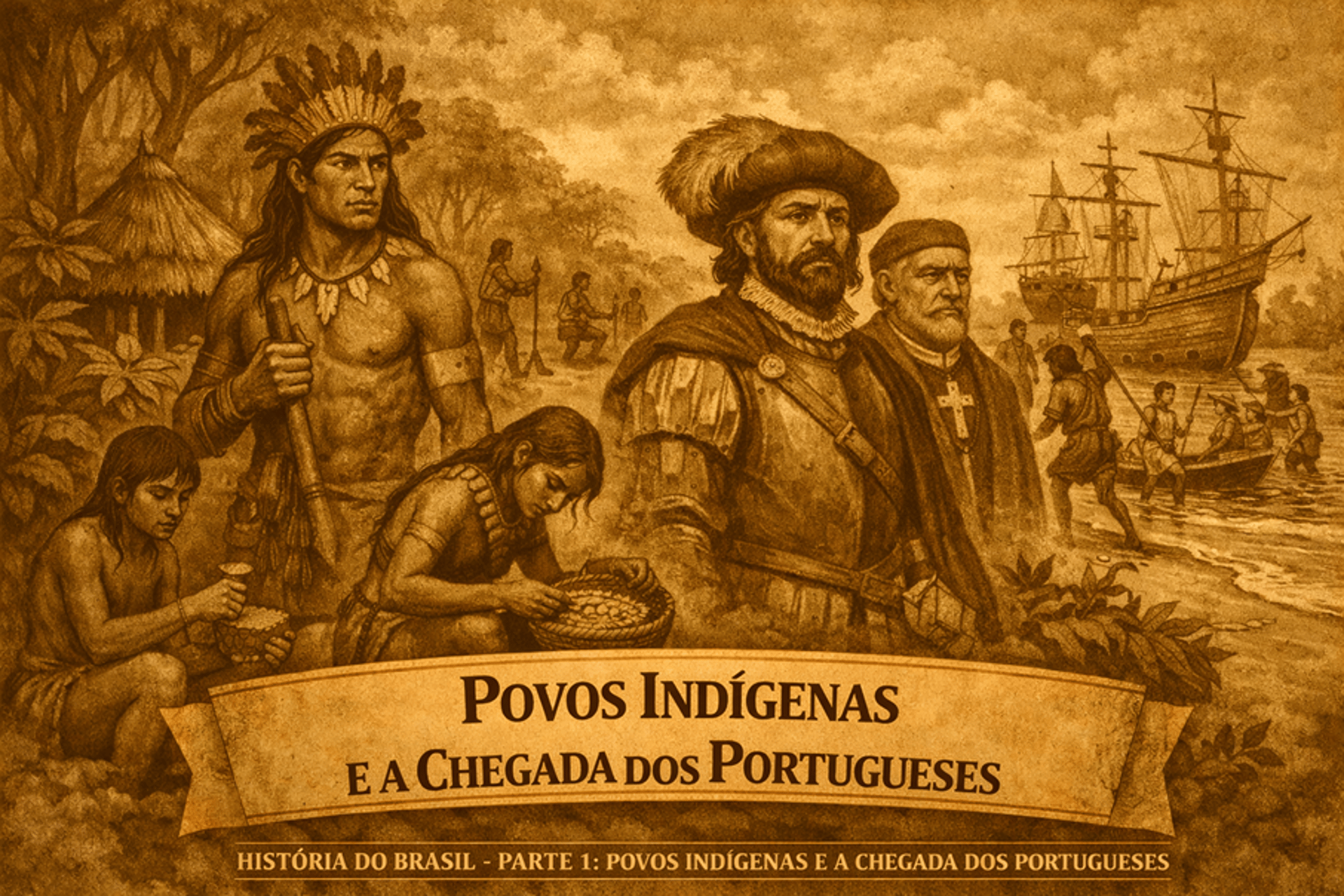
History of Brazil – Part 1: Indigenous Peoples and the Arrival of the Portuguese (1500-1549)
HISTÓRIAS DO BRASIL
Blog Toda História
12/15/2025
The Beginnings of Brazil Before 1500
Long before 1500, when Portuguese caravels first sighted the coast of Bahia, the vast land we now call Brazil was already alive with culture, diversity, and human presence. For thousands of years, millions of people had inhabited this territory — Indigenous peoples who shaped the land with wisdom, resilience, and a deep connection to nature.
The First Inhabitants of Brazil
Archaeological research indicates that the earliest human groups arrived in what is now Brazil at least 12,000 years ago — and possibly much earlier. They spread across every biome, from the Amazon to the Cerrado, from the coastline to the Pampas, adapting ingeniously to different environments and developing unique cultures.
These peoples did not form a single society, but rather a vast mosaic of civilizations. Each group had its own language, beliefs, and way of life. It is estimated that more than a thousand languages were spoken across the territory, belonging to linguistic families such as Tupi-Guarani, Macro-Jê, Arawak, and Carib. This diversity reflected the complexity and dynamism of pre-Cabralian Indigenous societies.
Culture, Agriculture, and Social Organization
While some groups were nomadic or semi-nomadic, living by hunting, fishing, and gathering, others established permanent villages, with houses organized around central plazas and a strong sense of community life.
Agriculture played a central role. Indigenous peoples cultivated cassava, maize, sweet potatoes, peanuts, and squash, using techniques such as slash-and-burn agriculture — the controlled cutting and burning of vegetation — demonstrating deep ecological knowledge.
In addition, they:
mastered forest management;
produced ceramics, tools, and weapons;
expressed art through body painting, dances, and ritual songs.
Spiritual life was marked by creation myths, nature spirits, and the figure of the pajé, the shaman responsible for healing and spiritual guidance.
Peoples and Regions
Several groups stood out in pre-colonial territorial organization:
Tupi: predominant along the coast, maintaining both commercial and warlike relations with other peoples.
Guarani: present in the south and central-west, guided by deep spirituality and the search for the mythical “Land Without Evil.”
Gê: inhabitants of the central plateau, organized into clans with strict hierarchical structures.
Yanomami: living in the Amazon rainforest in large communal houses (malocas), with strong social organization and profound respect for the forest.
These societies did not live in isolation. Trade networks connected distant regions, and Amazonian objects found in southern Brazil reveal long-distance routes of commerce and cultural exchange.
The Arrival of the Portuguese
The fate of the territory began to change in 1494 with the Treaty of Tordesillas, which divided the world between Portugal and Spain. Without knowing exactly what lay beyond the Atlantic, Portugal inherited a vast stretch of land that would eventually include Brazil.
On April 22, 1500, the expedition led by Pedro Álvares Cabral sighted the coast of Bahia. The region, named Porto Seguro, was described in the famous Letter of Pero Vaz de Caminha, which recorded the first contact between Europeans and Indigenous peoples — an encounter marked by curiosity, surprise, and wonder.
The Portuguese were impressed by the natural abundance, the hospitality of the natives, and the wealth of resources. However, their initial interest was not colonization, but the extraction of brazilwood, a valuable tree used in Europe for dyeing textiles.
For decades, extraction occurred through barter, with simple goods — such as mirrors, knives, and beads — exchanged for wood cut and transported by Indigenous labor.
Colonization and the Beginning of Colonial Brazil
Over time, other European powers, including the French and the Dutch, began to challenge Portuguese control. To secure its claim, Portugal sent the expedition of Martim Afonso de Sousa in 1530, marking the start of effective colonization.
In 1534, the territory was divided into hereditary captaincies, administered by Portuguese nobles known as donatários. The system largely failed due to Indigenous resistance, lack of resources, and geographic isolation.
To centralize authority, the Portuguese Crown established the General Government in 1549, appointing Tomé de Sousa as the first governor-general and founding Salvador, the first capital of Brazil.
With him came missionaries, soldiers, farmers, and the first enslaved Africans, forcibly brought to work on the sugar plantations that emerged in the Northeast.
Thus began the long and complex process of forming Colonial Brazil, marked by:
cultural clashes,
Indigenous resistance,
economic exploitation,
and the emergence of a new identity shaped by the encounter of peoples, languages, and traditions.
For further reading, most recommended works on Brazilian history are available in Portuguese.
Read more:
Email:
Give your Feedback:
contato.todahistoria@gmail.com
© 2025-2026 Todo História - All rights reserved.
This website may contain affiliate links.
By submitting the form, you represent that you agree to the Terms of Use and the Privacy Policy. The content of this message is not shared with Brevo.