
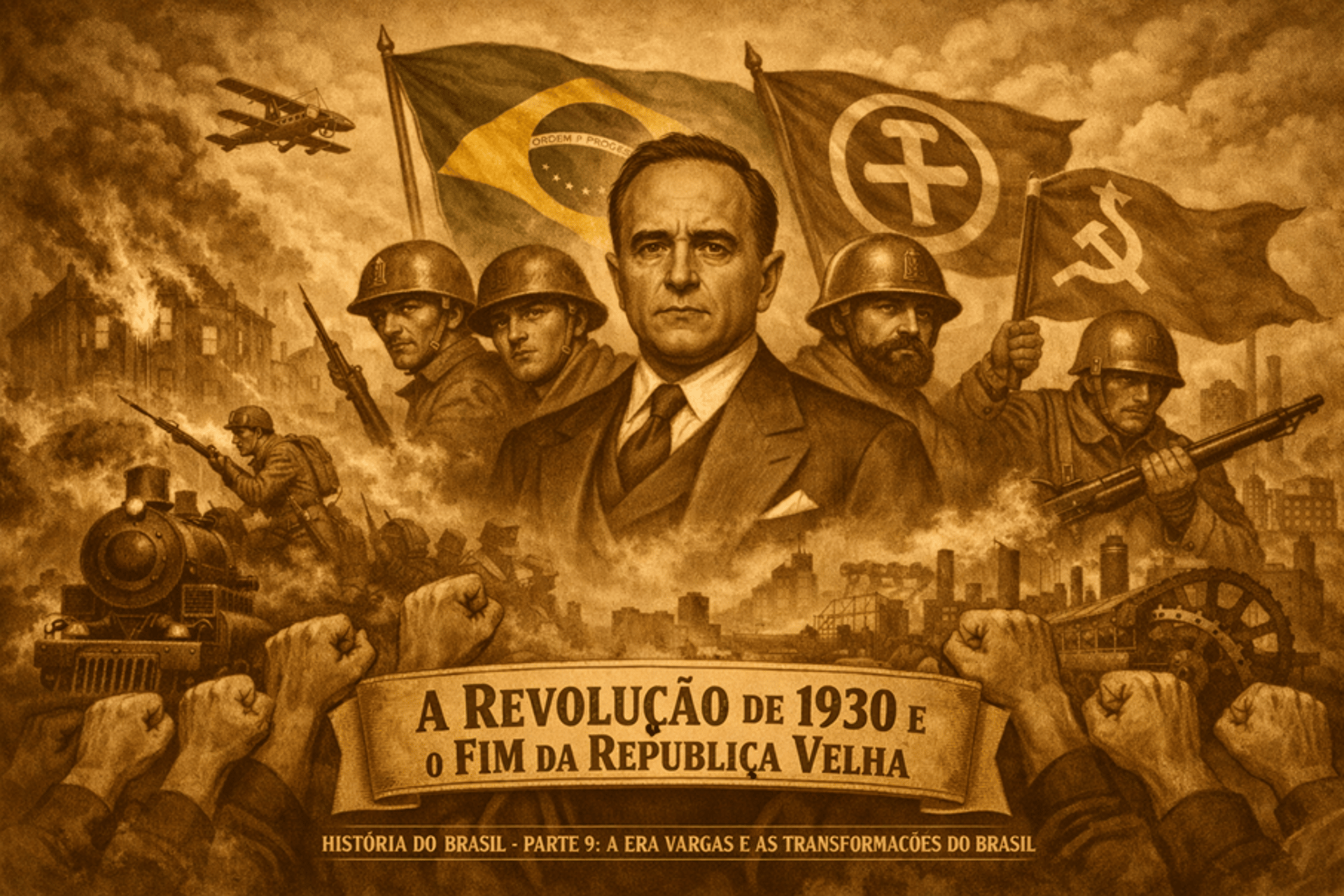
History of Brazil – Part 9: The Vargas Era and the Transformations of Brazil (1930–1945)
HISTÓRIAS DO BRASIL
Blog Toda História
2/4/2026
The 1930 Revolution and the End of the Old Republic
The 1930 Revolution marked the end of the Old Republic and the beginning of one of the most important and complex periods in Brazilian history: the Vargas Era. Getúlio Vargas came to power promising to break the dominance of the oligarchies, modernize the country, and expand the role of the state in the economy and social life.
The 1930 movement was not a popular revolution in the classical sense, but rather a political and military articulation that brought together dissatisfied sectors of regional elites, young Army officers, and emerging urban groups. The economic crisis triggered by the 1929 New York Stock Exchange crash accelerated the collapse of the coffee-based agro-export model and definitively weakened the government of the Old Republic.
The Provisional Government and the Centralization of Power (1930–1934)
Getúlio Vargas initially assumed power as head of a Provisional Government. The National Congress was dissolved, state governors were removed, and federal intervenors were appointed to govern the states. This centralization marked the beginning of a new political model, in which the state took on a more active role in directing the country.
During the first years, Vargas governed without a Constitution, arguing that Brazil needed to be reorganized. This period was marked by intense political disputes, especially with the São Paulo elites, who lost political influence after decades of dominance during the Old Republic.
The Constitutionalist Revolution of 1932
Dissatisfied with the loss of political influence, the elites of São Paulo led the Constitutionalist Revolution of 1932, demanding the convening of a Constituent Assembly and the restoration of constitutional order.
Although militarily defeated, the movement achieved important political results. Vargas was pressured to meet part of the demands and called elections for a Constituent Assembly, paving the way for the drafting of a new Constitution.
The 1934 Constitution and Laborism
In 1934, a new Constitution was promulgated, introducing significant advances. The text established secret ballots, women’s suffrage, basic labor rights, and greater state intervention in the economy. For the first time, the Brazilian state formally assumed responsibility for regulating relations between capital and labor.
In this context, Vargas sought support from urban classes and workers. The government began creating official unions linked to the state and presenting itself as a mediator of social conflicts. This strategy gave rise to laborism, a political current that defended state protection of workers and strengthened Vargas’s image as a leader close to the popular classes.
Political Radicalization and the Communist Uprising
The 1930s were marked by strong political instability worldwide, with the rise of authoritarian regimes such as fascism and Nazism—ideologies that advocated centralized, nationalist, authoritarian governments opposed to liberal democracies.
In Brazil, movements inspired by these ideas emerged, such as the Brazilian Integralist Action, a fascist-inspired political organization that defended order, extreme nationalism, anti-communism, and strong state authority. Integralism was nationalist, meaning it placed the nation above individual interests and rejected foreign influences.
In opposition, left-wing groups linked to communism also gained strength—an ideology that proposed the abolition of private ownership of the means of production, social equality, and control of the economy by workers or the state.
In 1935, the Communist Uprising (Intentona Comunista) took place, an attempted revolt led by left-wing military and civilian sectors. The movement was quickly suppressed but served as justification for Vargas to harden the regime and expand political control.
The 1937 Coup and the Estado Novo
In 1937, alleging the existence of a communist threat and using a false plan known as the Cohen Plan—a forged document describing an alleged communist conspiracy to seize power—Getúlio Vargas carried out a coup d’état and established the Estado Novo.
Congress was closed, the 1934 Constitution was suspended, and a new authoritarian Constitution was imposed, concentrating broad powers in the hands of the president.
During the Estado Novo, Vargas ruled in a dictatorial manner. Political parties were banned, censorship was intensified, and opponents were persecuted. At the same time, the government invested heavily in official propaganda, building the image of Vargas as the “father of the poor,” an expression linked to labor policies and the idea that the president protected urban workers through social laws and benefits.
Industrialization and State Intervention
Despite its authoritarian nature, the Estado Novo was a period of profound economic transformation. The government adopted an industrialization policy focused on import substitution, seeking to reduce external dependence.
Large state-owned enterprises were created, such as the National Steel Company (CSN), responsible for steel production—an essential raw material for heavy industry, infrastructure, transportation, and armaments—making it strategic for the country’s industrial development.
The Consolidation of Labor Laws (CLT)
Labor legislation advanced significantly during this period. In 1943, the Consolidation of Labor Laws (CLT) was enacted, regulating rights such as minimum wage, working hours, paid vacations, and weekly rest.
These measures strengthened the bond between the Vargas government and urban workers. However, unions were only recognized if subordinated to the state, which limited their autonomy and concentrated power in the hands of the government.
World War II and the Weakening of the Estado Novo
Brazilian foreign policy underwent important changes during World War II. Initially, Brazil maintained a position of neutrality, negotiating with both Axis and Allied countries.
After attacks on Brazilian ships, the country officially entered the war on the side of the Allies in 1942. Brazil sent the Brazilian Expeditionary Force (FEB) to fight in Italy, an experience that had a strong political and social impact.
Soldiers who fought authoritarian regimes abroad returned to Brazil questioning the existence of an internal dictatorship, contributing to the weakening of the Estado Novo.
The Fall of Vargas and the Legacy of the Vargas Era
At the end of the war, pressure for redemocratization grew. Sectors of society, the Armed Forces, and the press began demanding free elections and the end of the authoritarian regime. In 1945, Getúlio Vargas was overthrown by a movement led by the very military forces that had supported him.
The Vargas Era left a deep and contradictory legacy. It consolidated labor rights, promoted industrialization, and strengthened the role of the state, but it was also marked by authoritarianism, political repression, and restrictions on democratic freedoms.
This period was fundamental in shaping modern Brazil and profoundly influenced politics, the economy, and society in the decades that followed. Even after his fall, Getúlio Vargas would remain a central figure in Brazilian history, returning to power years later in a new democratic context.
For further reading, most recommended works on Brazilian history are available in Portuguese.
Read more:
Email:
Give your Feedback:
contato.todahistoria@gmail.com
© 2025-2026 Todo História - All rights reserved.
This website may contain affiliate links.
By submitting the form, you represent that you agree to the Terms of Use and the Privacy Policy. The content of this message is not shared with Brevo.