
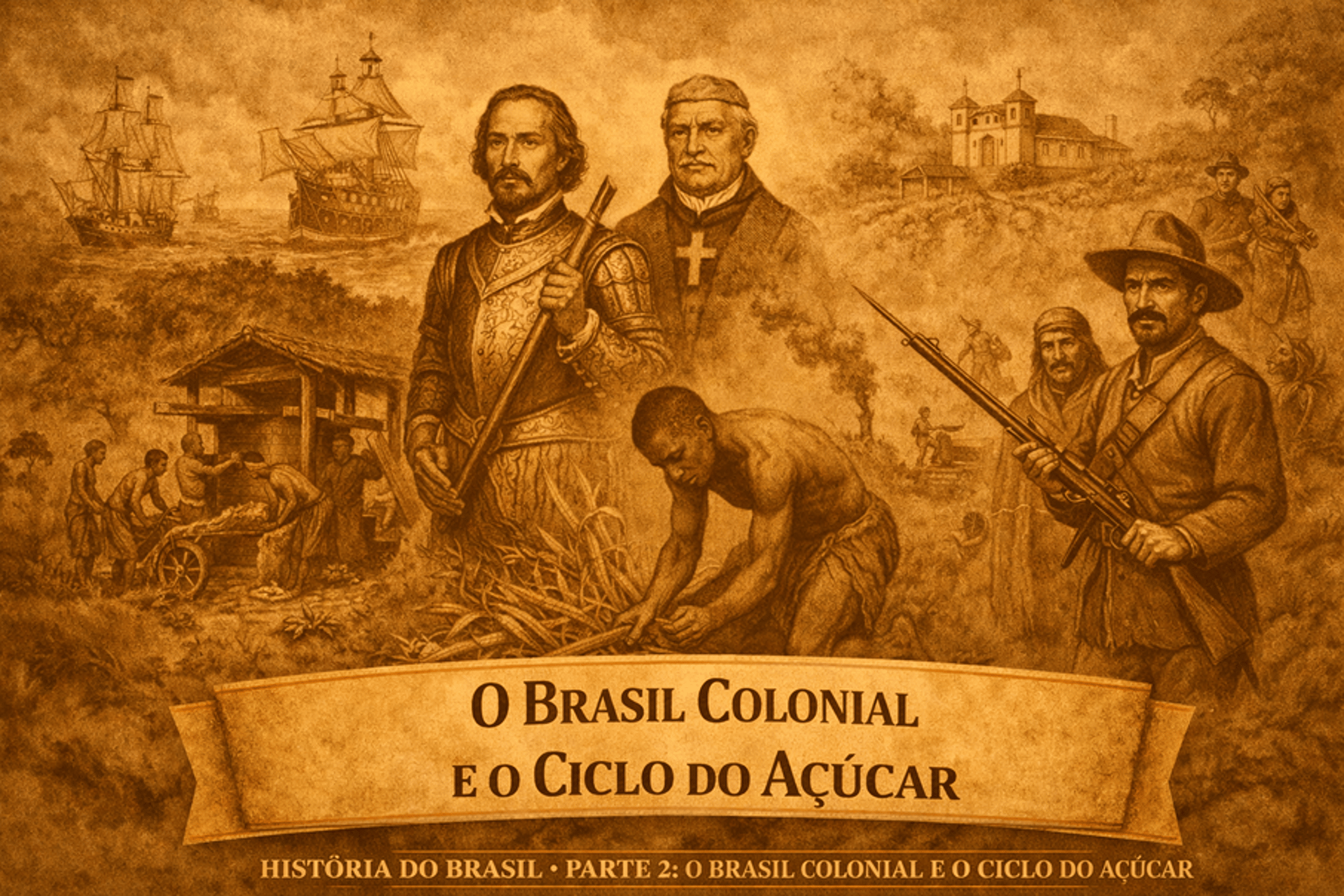
History of Brazil – Part 2: Colonial Brazil and the Sugar Cycle (XVI e XVII)
HISTÓRIAS DO BRASIL
Blog Toda História
12/23/2025
Escreva seu texto aqui...The Beginning of the Colonization of Brazil
After the first encounter between the Portuguese and Indigenous peoples in 1500, Brazil entered a new era: colonization. What had once been a distant and scarcely explored land soon became a key element in the ambitions of the Portuguese Empire. Initially neglected in favor of the lucrative trade with the Indies, Brazilian territory gradually gained strategic importance as other European powers—such as France and the Netherlands—began to compete for space in the Americas.
The Hereditary Captaincies
In 1534, King Dom João III established the system of Hereditary Captaincies, dividing Brazil into large strips of land granted to nobles and military men, known as donatários. Their mission was clear: to populate, administer, and defend the territory.
However, the project faced numerous obstacles. Indigenous resistance, lack of resources, communication difficulties, and geographic isolation caused most captaincies to fail. Only Pernambuco and São Vicente prospered, mainly sustained by sugar production and local efforts.
The General Government and the Founding of Salvador
To curb administrative disorder and centralize power, Portugal created the General Government in 1549, appointing Tomé de Sousa as the first governor-general. He founded the city of Salvador, which became Brazil’s first capital and a symbol of the beginning of a more structured Colonial Brazil.
Soldiers, technicians, and Jesuit missionaries arrived with him. The Jesuits’ mission was to convert Indigenous peoples to Christianity, establishing schools and settlements that deeply shaped the colony’s social and religious life—often in conflict with settlers interested in Indigenous enslavement.
The Sugar Cycle: Wealth and Slavery
With the new administrative structure, the Sugar Cycle gained strength between the 16th and 17th centuries. Regions such as Pernambuco and Bahia became major production centers, with sugar mills sustaining the colonial economy.
This wealth, however, came at a devastating human cost. Indigenous resistance and Jesuit influence contributed to the replacement of native labor with African slavery. Millions of Africans were kidnapped, transported under inhumane conditions, and forced to work in the sugar mills. This cruel system sustained the colonial empire and left deep marks on Brazilian history and culture.
Colonial Society: Power and Inequality
Colonial Brazilian society was rigidly hierarchical. At the top were the sugar mill owners, who concentrated land, enslaved labor, and political power. Below them were poor free men—soldiers, artisans, and small farmers—living in conditions of dependence. At the base of the social pyramid were enslaved Africans and Indigenous peoples, who sustained the system through forced labor.
Cities were small, with Salvador, Recife, and Olinda standing out as administrative and commercial centers. Most of the population lived in rural areas, without access to formal education or basic rights.
Foreign Invasions and Resistance
The 16th and 17th centuries were marked by attempts at foreign invasion.
The French sought to establish themselves in Guanabara Bay (France Antarctique, 1555–1567) and in Maranhão (France Équinoxiale, 1612–1615), but were expelled by the Portuguese.
The Dutch, in turn, occupied Pernambuco between 1630 and 1654. Under the rule of Maurício de Nassau, Recife experienced urban, scientific, and cultural advancements. Nevertheless, Luso-Brazilian resistance eventually expelled the Dutch, reinforcing Portuguese dominance over the region.
The Bandeirantes and Territorial Expansion
While sugar sustained the colonial economy, the bandeiras from São Paulo advanced into the interior of the territory. Their goals were to search for gold, precious stones, and to capture Indigenous people for enslavement.
These expeditions expanded Brazil’s borders beyond the Treaty of Tordesillas, shaping much of the country’s current territory. However, they also left a trail of violence, destruction, and suffering among Indigenous peoples.
The Legacy of the Sugar Cycle
The sugar-based economy generated wealth for a few and deep economic dependence on Portugal for many. Brazil became firmly established as a supplier of raw materials, while manufactured goods continued to come from Europe.
Culturally, the colonial period was marked by the fusion of Portuguese, African, and Indigenous elements. The Catholic Church exerted strong influence over social life, and from the blending of traditions, music, and beliefs emerged a unique Brazilian identity—born from pain, resistance, and the coexistence of distinct worlds.
For further reading, most recommended works on Brazilian history are available in Portuguese.
Read more:
Email:
Give your Feedback:
contato.todahistoria@gmail.com
© 2025-2026 Todo História - All rights reserved.
This website may contain affiliate links.
By submitting the form, you represent that you agree to the Terms of Use and the Privacy Policy. The content of this message is not shared with Brevo.