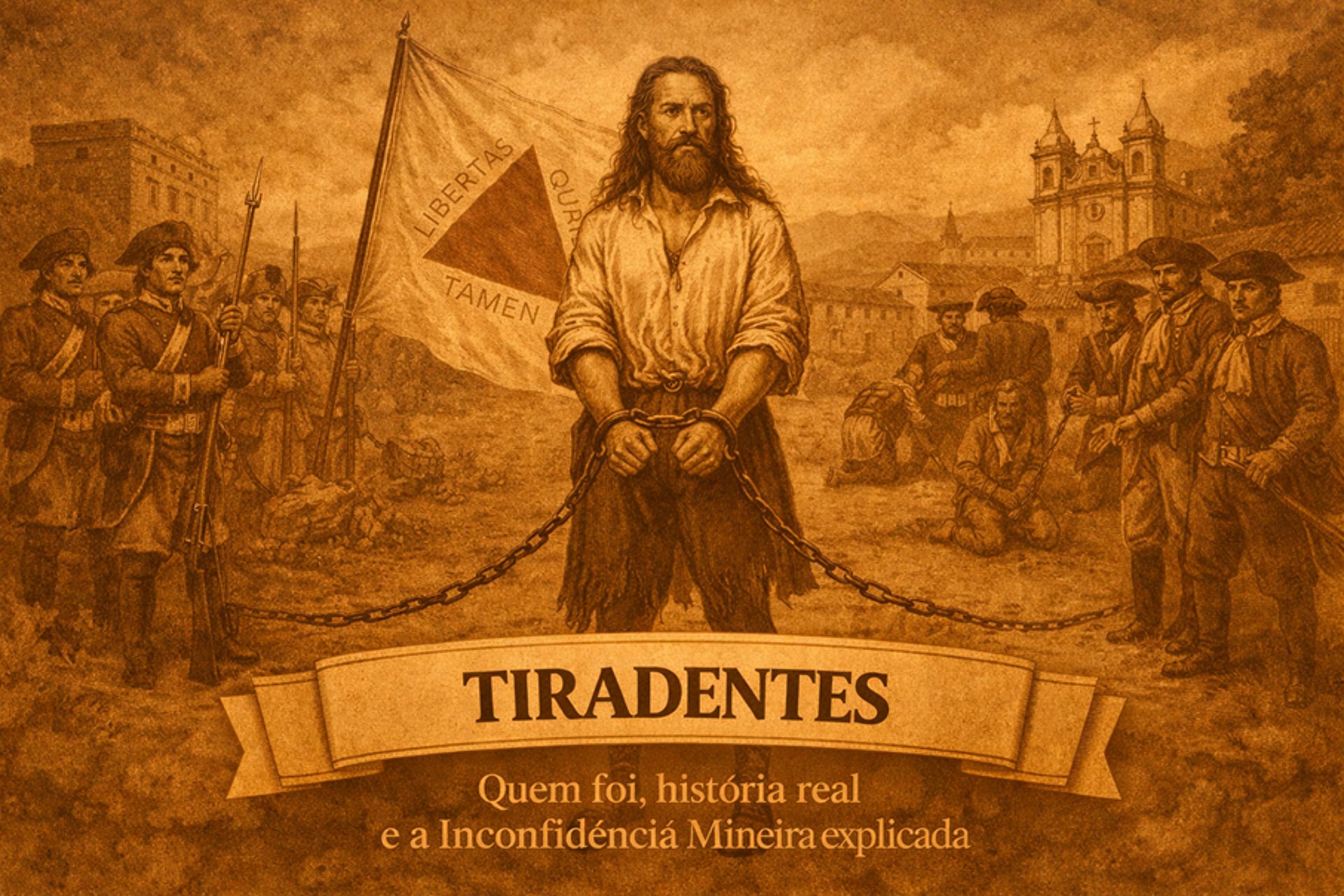
Tiradentes: who he was, his real story, and the Inconfidência Mineira explained
HISTÓRIAS DO BRASILNOVA POSTAGEM
Blog Toda História
4/18/2026
General context
In the 18th century, Brazil was still a colony of Portugal, and the region of Minas Gerais played a central role in the economy due to gold production — a topic explored in greater detail in The Gold Cycle and the Transformations of the 18th Century. For decades, this activity sustained the revenue of the Portuguese Crown.
Over time, the gold deposits began to run out. Production declined, but taxes remained high. Levies such as the “quinto” — which corresponded to 20% of all extracted gold — continued to be strictly enforced. In addition, there was the threat of the “derrama,” a forced tax collection applied when revenue targets were not met.
This scenario generated economic and political tensions, especially among sectors of the colonial elite.
Who was Tiradentes
In 1746, Tiradentes was born on Fazenda do Pombal, in Minas Gerais. He was the fourth son of Domingos da Silva Santos, of Portuguese origin, and Antônia da Encarnação Xavier.
Among his known siblings were:
– Father Domingos da Silva Xavier
– Maria Vitória da Silva Xavier
– Father Antônio da Silva Xavier
– Captain José da Silva Santos
– Catarina Eufrásia da Encarnação Xavier
– Eufrásia Maria da Assunção
– Antônia Rita de Jesus Xavier
(Records vary between seven and eight siblings in total.)
Contrary to the popular image later constructed, his family was not poor. Historical inventories indicate that they owned land, agricultural production, and dozens of enslaved people, used in farming, domestic work, and mining.
However, this situation did not last. After the death of his mother in 1755 and his father in 1757, the family faced financial difficulties and lost much of their property. As a result, the family dispersed, and Tiradentes went to live under the care of his uncle and godfather, Sebastião Ferreira Leitão, who worked as a practical surgeon.
Without access to formal academic education, he developed knowledge through practical experience throughout his life.
Youth and activities
During his youth, Tiradentes worked in several occupations, which was common outside the most privileged groups of the colony.
He was involved in mining, trade, and the transportation of goods between regions. He also learned dental practices from his uncle, which earned him the nickname by which he became known.
There are records indicating that, like other men of his time and social position, he was also part of the slave system. At certain times, he owned enslaved people as part of his economic activities.
These elements show that Tiradentes was not outside the social structure of his time, but fully inserted within it.
Military career
In the 1780s, he joined the troops of the Captaincy of Minas Gerais, reaching the rank of ensign (alferes).
His duties involved patrolling strategic routes and controlling the circulation of gold, especially along the paths connecting Minas Gerais to Rio de Janeiro.
This role allowed him to have direct contact with the mechanisms of control used by the Portuguese Crown and the difficulties faced by the population.
Despite his experience, he did not advance in rank, remaining in the same position, which reflected the social limitations of the time.
Crisis and circulation of ideas
The decline in gold production and increased tax pressure worsened the region’s situation. At the same time, ideas inspired by the Enlightenment began to circulate, along with external influences such as the independence of the United States, promoting political freedom and autonomy.
These ideas found support among members of the colonial elite, who began to question Portuguese rule.
The Inconfidência Mineira
In this context emerged the Inconfidência Mineira, a movement that sought to separate the captaincy of Minas Gerais from Portugal and establish a republic.
The movement involved different groups, including military officers, intellectuals, and landowners. There were shared proposals, such as ending Portuguese control and reorganizing the economy, but not everyone agreed on issues like slavery.
Tiradentes played a prominent role mainly in spreading the movement’s ideas. His more open and less cautious behavior made him more visible.
The flag of the Inconfidência Mineira
One of the main symbols of the Inconfidência Mineira is the flag that later inspired the current flag of Minas Gerais. It features a red triangle on a white background, along with the Latin phrase “Libertas quæ sera tamen.”
The triangle, associated with Tiradentes, is linked both to the Holy Trinity and to ideals of freedom. The red color symbolizes struggle, while the white represents the desire for peace. The phrase, inspired by Virgil and attributed to Alvarenga Peixoto, means “Liberty, even if late,” summarizing the movement’s goal.
Discovery and repression
The movement was denounced in 1789 by Joaquim Silvério dos Reis, a member of the conspiracy itself. In return, he sought benefits from the Portuguese Crown, such as debt forgiveness.
This led to an investigation conducted by colonial authorities.
Those involved were arrested and interrogated. Tiradentes was detained in Rio de Janeiro, where he was at the time.
The conspiracy was dismantled before it could be put into action.
Trial and sentencing
The accused were tried for the crime of lèse-majesté. The process lasted about three years.
Most of those involved had their sentences commuted to exile. Tiradentes was the only one sentenced to death.
His more exposed role, combined with his social position, contributed to his selection as an example.
Execution
The execution took place on April 21, 1792, in Rio de Janeiro.
During his imprisonment, he faced conditions that included isolation and preparation for punishment. On the eve of his execution, his hair and beard were shaved, as required by the penal system of the time.
This contrasts with the more widely known image, later constructed, which portrays him with a long beard and a religious-like appearance.
The fate of Joaquim Silvério dos Reis
After the denunciation, Joaquim Silvério dos Reis faced strong rejection. He moved to Lisbon, where he remained for years.
He returned to Brazil in 1808, alongside the transfer of the Portuguese court — an event that marked a new phase in history, detailed in The Arrival of the Royal Family and the Road to Independence (1807–1822). In his final years, he settled in Maranhão, where he served as a commander of auxiliary forces.
He died in 1819 in São Luís, where he was buried.
Over time, his image became associated with betrayal, often compared to symbolic figures such as Judas in popular interpretations.
The construction of Tiradentes’ image
The most widely known image of Tiradentes does not match his real appearance.
As a military man, he followed strict grooming standards, with short hair and no long beard. Records also indicate that at the time of his execution, his head was shaved.
The representation with long hair and beard emerged after the Proclamation of the Republic, when his image was reconstructed as a national symbol — a process linked to the creation of republican symbols, as explained in The Proclamation of the Republic and the Old Republic (1889–1930).
This process reinforced his association with the idea of martyrdom.
Historical significance
After the Republic, Tiradentes came to be recognized as a national hero. April 21 was established as a national holiday.
His figure came to represent resistance against colonial rule and the pursuit of political autonomy.
Conclusion
Tiradentes’ life is part of the broader economic and political transformations of colonial Brazil.
His participation in the Inconfidência Mineira placed him as one of the central figures of the movement, which, although unsuccessful, revealed deep tensions within society at the time.
Over time, his image was reinterpreted, shifting from a condemned traitor to a symbol of national history.
Read more:
Email:
Give your Feedback:
contato.todahistoria@gmail.com
© 2025-2026 Todo História - All rights reserved.
This website may contain affiliate links.
By submitting the form, you represent that you agree to the Terms of Use and the Privacy Policy. The content of this message is not shared with Brevo.