
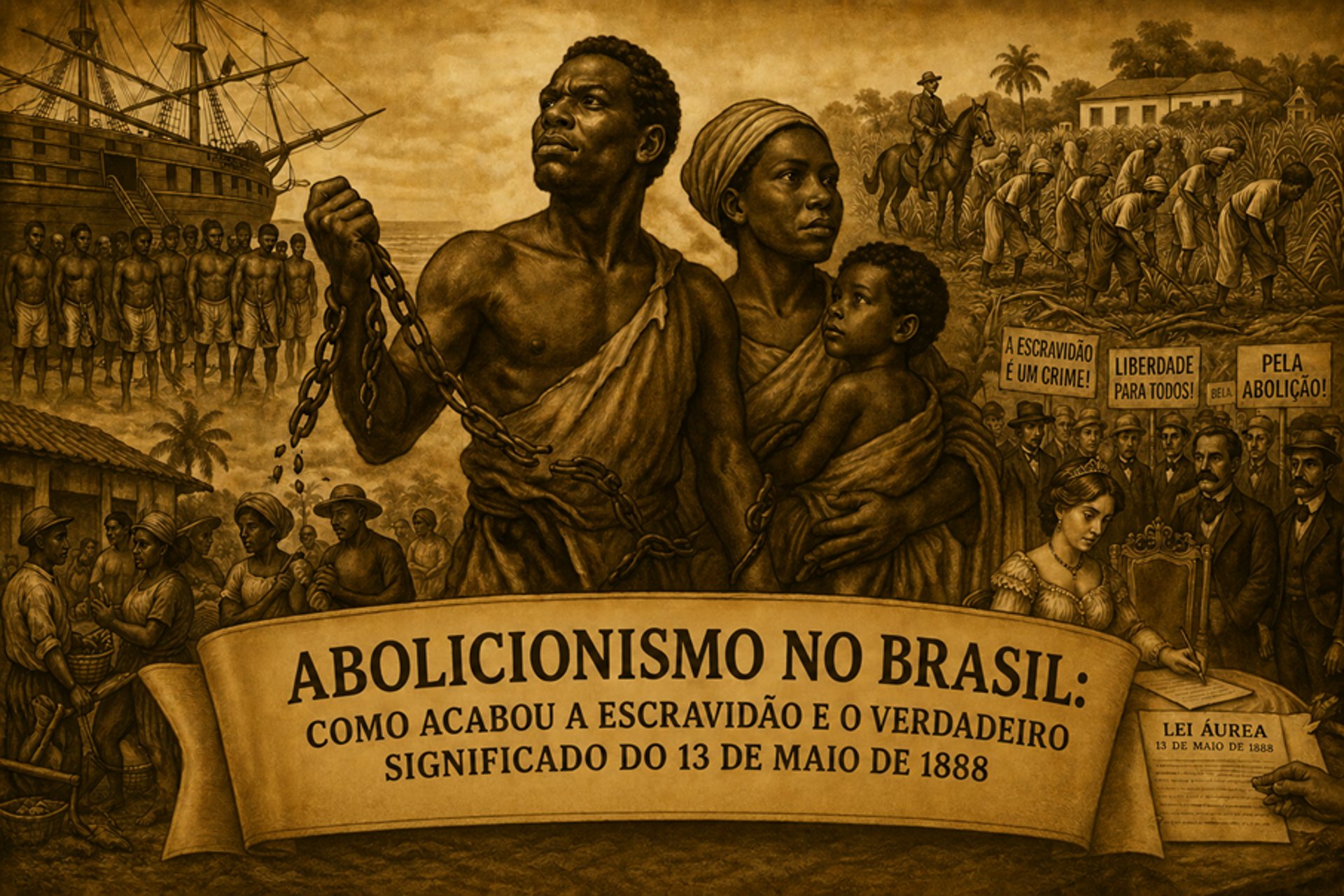
Abolitionism in Brazil: How Slavery Ended and the True Meaning of May 13, 1888
HISTÓRIAS DO BRASILNOVA POSTAGEM
Blog Toda Hitória
5/4/2026
General Context
For nearly four centuries, Brazil lived under a system based on slavery. Between the 16th and 19th centuries, around 4 to 5 million Africans were forcibly brought to the country — the largest number in the entire American continent. At the same time, Indigenous peoples were also enslaved, especially in the early years of colonization.
This system sustained the colonial and imperial economy, particularly in sugar production, mining, and later, coffee cultivation.
Throughout the 19th century, this model began to be questioned. International pressure, especially from England, led to the prohibition of the slave trade in 1850. Internally, the system itself was already showing signs of decline, in a context of instability that can also be observed in periods such as described in History of Brazil – Part 6: The Regency Period and Internal Revolts (1831–1840).
Even so, slavery did not end immediately. The government created gradual laws, such as the Law of the Free Womb (1871) and the Sexagenarian Law (1885), which did little to change reality.
It was only on May 13, 1888, that slavery was officially abolished with the signing of the Golden Law.
But that is not the whole story.
The Reality of Slavery
To understand abolitionism, it is first necessary to understand what slavery actually was.
Millions of Africans were captured, separated from their families, and transported in slave ships known as “tumbeiros” — so called because many died during the crossing. It is estimated that about 15% of the people did not survive the journey, victims of hunger, disease, and violence.
Upon arriving in Brazil, they were treated as merchandise.
The lives of enslaved people were marked by exhausting workdays, often exceeding 15 hours per day, poor nutrition, and constant violence. Physical punishments, such as whipping, were common, as was the use of restraining instruments to prevent escape.
They lived in senzalas (slave quarters), overcrowded places with no basic hygiene conditions. Enslaved women, in addition to forced labor, were frequently subjected to abuse.
There were different roles:
field labor (the most exploited)
domestic work
urban activities, such as street vendors and porters
Even in the face of this reality, there was resistance.
Escapes, revolts, and the formation of quilombos — such as the famous Quilombo dos Palmares — showed that slavery was never passively accepted. In addition, enslaved people kept their cultures, religions, and traditions alive, often in secret.
Abolitionism, therefore, did not arise only from political decisions.
It was the direct result of the resistance of the enslaved themselves, combined with the actions of intellectuals, journalists, lawyers, and social movements that began to pressure for the end of the system.
Conclusion: The Meaning of May 13
May 13, 1888, officially marks the end of slavery in Brazil. However, this date carries a more complex meaning than is often presented.
Abolition was not an act of generosity by the monarchy, nor solely the result of Princess Isabel’s signature, but part of a broader historical process, also connected to the political transformations explained in The Proclamation of the Republic and the Old Republic (1889–1930). It was the outcome of centuries of struggle, resistance, and social pressure.
Moreover, freedom came without any form of support.
Millions of people were freed without access to land, education, or decent work. In practice, they were left to fend for themselves, contributing to the formation of inequalities that still exist in Brazil today.
For this reason, May 13 is not just a historical date.
Unlike other national dates, it did not become a public holiday in Brazil. This is because, over time, the way this event has been interpreted has changed.
Abolition stopped being seen as an act of generosity by the monarchy and came to be understood as the result of the struggle of the enslaved themselves. In addition, the fact that millions were freed without any support led the date to be increasingly treated as a moment of reflection — rather than celebration.
For this reason, other dates have gained more prominence, such as November 20, which highlights Black resistance and the ongoing struggle for freedom throughout history.
Read more:
Email:
Give your Feedback:
contato.todahistoria@gmail.com
© 2025-2026 Todo História - All rights reserved.
This website may contain affiliate links.
By submitting the form, you represent that you agree to the Terms of Use and the Privacy Policy. The content of this message is not shared with Brevo.