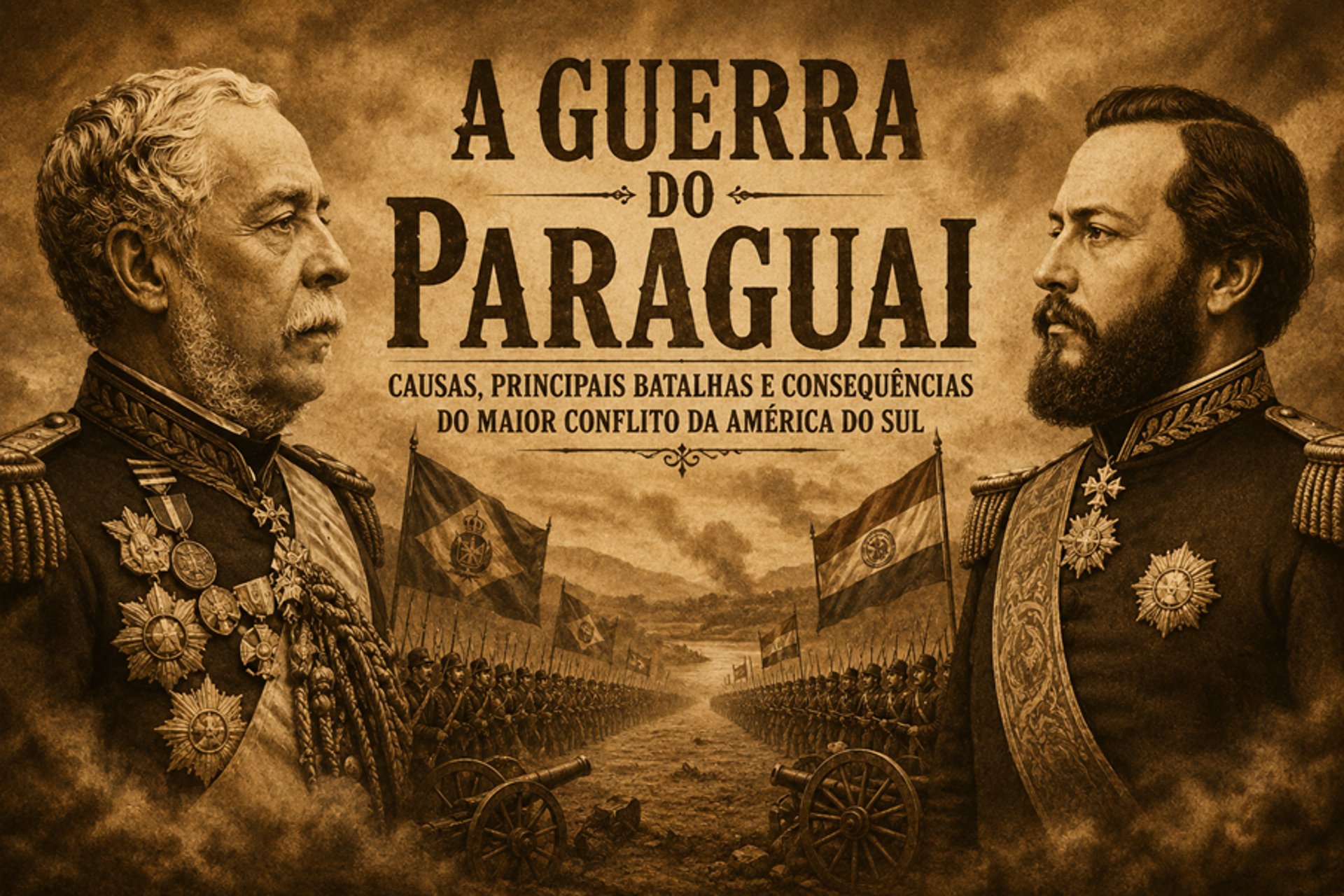
Paraguayan War: Causes, Major Battles, and Consequences of the Largest Conflict in South America
HISTÓRIAS DO BRASILNOVA POSTAGEM
Blog Toda História
6/17/2026
General Context
In the 19th century, the Río de la Plata Basin was one of the most disputed regions in South America. Brazil, Argentina, Paraguay, and Uruguay all had economic and political interests in the area, particularly regarding control of the rivers that served as important commercial and military routes.
Paraguay, governed by Francisco Solano López, sought to strengthen its regional position and avoid the country's economic isolation. At the same time, the Empire of Brazil closely monitored political conflicts in Uruguay, where internal disputes threatened Brazilian interests in the region.
In 1864, Brazil decided to intervene militarily in Uruguay to support the Colorado political faction against the Blanco government, which maintained close relations with Paraguay. Francisco Solano López interpreted this action as a direct threat to the regional balance of power and to Paraguay itself.
Tensions escalated rapidly.
In response to the Brazilian intervention, Paraguay seized the Brazilian vessel Marquês de Olinda and shortly afterward invaded the province of Mato Grosso. Paraguayan troops then requested passage through Argentine territory to attack southern Brazil. The Argentine government refused.
Even so, Solano López ordered the invasion of the Argentine province of Corrientes.
From that moment on, Argentina and Uruguay joined Brazil, forming the Triple Alliance against Paraguay.
Thus began the Paraguayan War, the largest armed conflict in South American history.
Paraguay's Response and the Beginning of the War
Francisco Solano López believed that Paraguay needed to act quickly before Brazil further expanded its influence in the Río de la Plata region.
From the Paraguayan government's perspective, the Brazilian intervention in Uruguay altered the regional political balance and threatened strategic access to the region's waterways. López also believed he could achieve rapid victories over his opponents before they organized a joint response.
It was in this context that the capture of the Brazilian vessel Marquês de Olinda took place in November 1864. The ship was navigating the Paraguay River carrying the new president of the province of Mato Grosso when it was intercepted by Paraguayan forces.
Shortly afterward, Paraguayan troops invaded Brazilian territory in Mato Grosso.
Initially, Paraguay achieved important military successes. At that time, the Paraguayan army was considered one of the most organized in South America, possessing strong military training and a high capacity for mobilization.
However, the situation changed when Solano López decided to expand the conflict.
By ordering the invasion of the Argentine province of Corrientes without the authorization of the Argentine government, López ultimately provoked Argentina's definitive entry into the war. Uruguay, already aligned with Brazil after its change of government, also joined the conflict.
In 1865, the three countries signed the Treaty of the Triple Alliance, committing themselves to defeating Paraguay.
The war ceased to be a limited regional conflict and came to involve virtually the entire Río de la Plata region.
The Naval Battle of Riachuelo
One of the most important battles of the war took place on June 11, 1865, on the waters of the Paraná River.
The Naval Battle of Riachuelo was decisive because control of the rivers was essential for transporting soldiers, weapons, food, and communications among the countries involved.
At that time, rivers functioned as true military highways.
The Brazilian fleet, commanded by Admiral Francisco Manuel Barroso, consisted of steam-powered vessels, a modern technology for the period. Paraguay also operated steamships, many of which had been hastily adapted for combat.
The Paraguayan plan was to launch a surprise attack against the Brazilian fleet before dawn.
But a mechanical problem completely changed the course of the operation.
One of the Paraguayan ships was delayed by failures in its propulsion system, causing the fleet to lose the element of surprise. By the time the Paraguayans finally approached the Brazilian fleet, the sun was already illuminating the Paraná River.
The Brazilians were able to spot the enemy before the attack.
Even so, the battle quickly descended into chaos.
The Paraguayans lured the Brazilian ships into a narrow area near the Riachuelo stream, where cannons hidden along the riverbanks opened fire on the imperial fleet.
Some Brazilian vessels ran aground on sandbanks.
The Jequitinhonha became trapped near enemy artillery and suffered severe damage. Meanwhile, the Parnaíba was surrounded and boarded by Paraguayan vessels, leading to fierce hand-to-hand combat on deck.
It was during this clash that sailor Marcílio Dias became one of the most famous figures of the war by fighting Paraguayan soldiers during the boarding of the ship.
For part of the battle, the Brazilian situation appeared close to disaster.
At that moment, Admiral Barroso made an extreme decision.
Aboard the frigate Amazonas, the largest ship in the Brazilian fleet, he ordered full speed directly toward the enemy vessels. Instead of relying solely on artillery, Barroso chose to use the ship's weight itself as a weapon.
The Amazonas advanced through the river and rammed Paraguayan vessels, destroying ships and completely disrupting the enemy formation.
The maneuver changed the course of the battle.
Unable to maintain formation and suffering heavy losses, the Paraguayan fleet began to retreat.
The Brazilian victory at Riachuelo had enormous strategic impact.
From that moment on, the Triple Alliance controlled much of the navigation on the region's rivers, isolating Paraguay and making it difficult to send supplies during the remainder of the war.
The Battle of Tuyutí
After the initial fighting, the troops of the Triple Alliance advanced toward Paraguayan territory.
It was in this context that, on May 24, 1866, the Battle of Tuyutí took place—considered the largest field battle in South American history.
The confrontation occurred in an area of flooded plains and difficult terrain in southern Paraguay.
Francisco Solano López believed he could still destroy the allied army with a massive surprise attack before Brazil, Argentina, and Uruguay consolidated their position inside Paraguayan territory.
The plan was ambitious.
Thousands of Paraguayan soldiers would advance simultaneously against different sectors of the allied camp, attempting to surround enemy forces and inflict a decisive defeat.
At the beginning of the battle, the Paraguayan attack had a strong impact.
The lines of the Triple Alliance were pressured at several points, especially in sectors occupied by Argentine and Uruguayan troops. In some areas, fighting occurred hand-to-hand amid smoke, mud, and artillery fire.
But there was a problem for the Paraguayans.
The terrain made rapid troop movements difficult, and the Allies possessed a significant advantage in artillery.
The Brazilian artillery, commanded by General Emílio Luís Mallet, played a decisive role in the battle.
To counter possible cavalry attacks, the Brazilians dug concealed trenches in front of their positions. When Paraguayan soldiers advanced, many became trapped or disorganized by these improvised defenses.
At that moment, the artillery opened fire.
Canister shots struck the Paraguayan lines at close range, causing enormous destruction. The advance lost momentum, and the battle turned into a massacre.
Throughout the day, successive Paraguayan attacks were repelled.
The human losses were enormous.
Paraguay lost thousands of soldiers, including many of its most experienced military personnel. From Tuyutí onward, the country faced immense difficulties in replacing its troops.
The battle marked an important turning point in the war.
After that defeat, Francisco Solano López gradually abandoned large-scale open-field offensives and instead relied on fortified defensive positions, attempting to wear down the allied armies over time.
The Battle of Curupayty
After the destruction caused at Tuiuti, many leaders of the Triple Alliance believed that Paraguay was close to collapse.
However, the war was still far from over.
On September 22, 1866, the Allies launched a major assault against the Paraguayan fortifications of Curupayty, a defensive position built in a region of swamps, mud, and dense vegetation along the banks of the Paraguay River.
The site had been carefully prepared by the Paraguayans.
Under the command of General José Eduvigis Díaz, trenches were dug throughout the area, while large hidden ditches hindered the advance of enemy infantry. Trees had been felled and arranged with sharpened branches, creating barriers that were nearly impossible to cross under enemy fire.
Behind these defenses, dozens of Paraguayan cannons waited silently.
The Triple Alliance's plan seemed straightforward.
Before the ground assault, Brazilian ironclad warships would bombard the Paraguayan positions for hours, destroying the defenses and clearing the way for the advancing troops.
But something went wrong.
The thick smoke from the bombardment and the difficulty of seeing the terrain caused much of the artillery fire to miss its intended targets. Many shells exploded behind the trenches or sank harmlessly into the swampy ground.
The main Paraguayan defensive positions remained largely intact.
Unaware of this, the Allied command ordered the advance.
Thousands of Brazilian and Argentine soldiers began crossing the flooded terrain toward the fortifications.
Then the Paraguayan artillery opened fire.
The advancing troops became trapped in hidden ditches and wooden obstacles scattered across the battlefield. Amid the mud, smoke, and artillery fire, their formations quickly fell into disorder.
The advance turned into chaos.
Each attempt to approach the defenses was met with devastating volleys of cannon and rifle fire, striking the Allied troops with little protection.
Within a few hours, the field in front of Curupayty was covered with dead and wounded soldiers.
The battle ended as one of the greatest military defeats in Brazilian history.
While the Allies suffered thousands of casualties, Paraguayan losses were comparatively small.
The defeat shocked the nations of the Triple Alliance and brought military operations to a halt for many months.
It was during this period of crisis that the Brazilian Empire decided to place the command of its land forces under the Marquis of Caxias, who would reorganize the army and prepare a new phase of the war.
The Crisis of the Triple Alliance and the Arrival of Caxias
The defeat at Curupayty deeply shook the Triple Alliance. What had been expected to be a swift campaign against Paraguay had become a long, costly, and increasingly unpopular war.
After the disaster, relations between Brazilian and Argentine commanders deteriorated rapidly. Argentine President Bartolomé Mitre, who also served as commander of the Allied forces, was accused by Brazilian officers of ordering a disastrous frontal assault against heavily fortified positions that remained largely undamaged. On the other hand, Mitre blamed the Brazilian Imperial Navy for failing to destroy the Paraguayan defenses during the naval bombardment that was supposed to precede the attack.
Trust between the Allies nearly vanished.
Military camps became increasingly disorganized, lacking effective coordination and plagued by disputes among officers. Meanwhile, the Allied armies suffered more from disease, hunger, and mud than from combat itself. Cholera and malaria epidemics spread through the camps, killing thousands of soldiers.
The situation became so critical that the Argentine government had to deal with internal revolts and political conflicts within its own territory. In 1867, Bartolomé Mitre was forced to return to Buenos Aires, leaving the front lines of the war.
At that moment, the Empire of Brazil assumed full control of military operations.
To reorganize the army, Emperor Dom Pedro II appointed Luís Alves de Lima e Silva, the Marquis of Caxias, as commander of the Brazilian forces.
When Caxias arrived at the front, he found a chaotic situation: demoralized soldiers, shortages of supplies, overcrowded hospitals, and troops poorly prepared to continue the campaign.
Instead of launching immediate attacks, Caxias chose to rebuild the army from the ground up.
He reorganized military camps, ordered wells to be dug to provide clean drinking water, and established more efficient military hospitals to combat disease outbreaks. He also improved food distribution, strengthened discipline, and introduced regular training programs to prepare soldiers for more modern and organized warfare.
At the same time, Caxias invested heavily in military technology and engineering.
During this period, the Allies began using observation balloons—an innovation in South American warfare—to map Paraguayan fortifications from the air. Telegraph lines were employed to speed communication between commanders, while military engineers built roads, bridges, and structures across swampy terrain previously considered nearly impassable.
The war was entering a new phase.
After nearly a year of quiet reorganization, the Allied army was no longer the disorganized force defeated at Curupayty. Under Caxias's leadership, Brazil, Argentina, and Uruguay were preparing to strike Paraguay's greatest defensive system: the massive Fortress of Humaitá.
The Siege of Humaitá and the Turning Point of the War
After completely reorganizing the Allied army, the Marquis of Caxias turned his attention to Paraguay's greatest military obstacle: the Fortress of Humaitá.
Located on the banks of the Paraguay River, Humaitá was considered nearly impregnable. The complex contained dozens of heavy cannons aimed at the river, miles of trenches, defensive barriers, and thousands of soldiers prepared to block any enemy advance toward Asunción.
The position was so strategic that many referred to Humaitá as the “Gibraltar of South America.”
Controlling the fortress meant controlling the main river route into the heart of Paraguay.
For this reason, rather than launching an immediate frontal assault—as had happened at Curupayty—Caxias adopted a strategy of gradual siege and attrition.
By late 1867, Triple Alliance forces had begun occupying positions around the fortress, slowly cutting Paraguayan supply routes. The objective was to isolate Humaitá and weaken its defenses before delivering a decisive blow.
However, there was one major problem.
Even surrounded on land, Humaitá still controlled the Paraguay River.
Paraguayan cannons dominated the narrow bends of the river, while heavy iron chains had been stretched from one bank to the other to block the passage of Brazilian warships. Any vessel attempting to advance would be forced to slow down under direct fire from the fortress.
Nevertheless, the Imperial Navy decided to attempt what seemed impossible.
In the early hours of February 19, 1868, a squadron of Brazilian ironclads silently advanced toward the Paraguayan batteries. These ships were steam-powered and protected by thick iron armor—a modern technology for the era that had been further developed during the war.
When the Paraguayans noticed the approaching fleet, they immediately opened fire.
The sky lit up with cannon blasts as shells struck the Brazilian ironclads at close range. Despite the intense bombardment, the ships continued moving slowly against the current.
The iron chains stretched across the river became the most critical moment of the operation.
Using the power of their steam engines and the weight of their armored hulls, the ironclads succeeded in breaking through or bypassing the barriers under heavy fire. The sound of explosions mixed with the metallic impacts striking the ships' armor.
Against all expectations, the Brazilian fleet passed Humaitá without losing a single vessel.
The so-called “Passage of Humaitá” became one of the most famous episodes of the Paraguayan War and demonstrated how military technology was beginning to transform warfare in the nineteenth century.
After that, Paraguay's situation became increasingly desperate.
With the river controlled by the Imperial Navy and Allied forces tightening the siege by land, Humaitá became completely isolated. Lacking food, ammunition, and reinforcements, Francisco Solano López realized that the fortress could not hold out much longer.
In March 1868, a large portion of the Paraguayan garrison secretly abandoned the position by crossing the surrounding swamps. Months later, in July, Allied forces finally occupied Humaitá, finding it largely destroyed and deserted.
The fall of the fortress opened the road for the Triple Alliance's final advance into the Paraguayan interior and marked the beginning of the decisive phase of the war.
The Piquissiri Maneuver: Caxias's Masterpiece
After the fall of Humaitá, the war entered a new phase. The road to Asunción seemed open, but Francisco Solano López still possessed a powerful defensive system known as the Piquissiri Line.
The position took advantage of the region's natural features. Trenches protected the land approaches, while flooded areas and swamps made any enemy advance extremely difficult. In addition, dozens of cannons defended the fortress of Angostura, which controlled one of the most important passages along the Paraguay River.
For many commanders, the only option seemed to be a frontal assault.
Caxias thought differently.
A veteran of decades of military campaigns, he knew that a direct attack could become another disaster like Curupayty. Instead of attacking the enemy's strongest position, he decided to find a route that no one considered possible.
His plan was to outflank the entire Paraguayan defensive line through the Chaco, a region of swamps, forests, and extremely difficult terrain.
The problem was that no roads existed there.
To make the operation possible, Brazilian engineers and soldiers began a massive military construction project. Thousands of men spent weeks cutting palm trees and logs to build a road across the flooded ground.
Thousands of logs were placed side by side over the mud, forming a kind of wooden causeway capable of supporting soldiers, cavalry, wagons, and heavy artillery.
While the road was being built, the Imperial Navy ensured the operation's security.
Brazilian ironclads patrolled the Paraguay River and protected the work crews. These vessels represented some of the most advanced military technology of the era. Unlike traditional wooden warships, they were protected by thick iron armor capable of resisting Paraguayan artillery fire.
Powered by steam engines, they could also navigate against strong currents and operate in narrow rivers, making them essential to the campaign's success.
When the road was completed, thousands of soldiers secretly crossed the Chaco and emerged behind the Paraguayan positions.
The surprise was enormous.
Instead of confronting the Allies through carefully prepared fortifications, Solano López found his army threatened from the rear. The Piquissiri Line had been outflanked.
From that moment on, the war entered its decisive stage. To stop the Allied advance toward Asunción, the Paraguayans were forced to abandon part of their defenses and face the Triple Alliance armies in a series of battles known as the December Campaign, including Itororó, Avaí, and Lomas Valentinas.
The Battle of Itororó (December 6, 1868)
Following the success of the Piquissiri Maneuver, the Allied army advanced deeper into Paraguay. Before continuing, however, it had to overcome what appeared to be a simple obstacle: a wooden bridge spanning the Itororó Stream.
The location, however, was a natural trap. The stream had steep banks, a strong current, and enough depth to prevent any crossing away from the bridge. Whoever controlled that passage controlled the road north.
Francisco Solano López understood the strategic importance of the position and sent approximately 5,000 soldiers under Colonel Bernardino Caballero to defend it. Paraguayan forces occupied the hills overlooking the bridge and placed artillery and infantry positions among the vegetation.
On the morning of December 6, 1868, Brazilian troops launched their attack. The objective seemed straightforward: cross the bridge and drive out the defenders. In practice, it became a nightmare.
The bridge was too narrow to allow large formations to advance. Soldiers had to cross in tightly packed columns, making them easy targets for enemy artillery. From the surrounding hills, Paraguayan gunners fired grapeshot—ammunition consisting of dozens of iron balls that spread across the battlefield like a giant shotgun blast.
Every attempt ended the same way. Brazilian troops crossed under heavy fire, reached the opposite bank, and were pushed back by Paraguayan counterattacks. Soon, the bridge and the stream were covered in smoke, debris, and bodies.
For hours, the battle remained undecided.
Brazilian artillery tried to respond, but faced a difficult challenge: Paraguayan guns were concealed among trees and trenches on the hilltops. Often, Brazilian gunners had to fire by aiming at the smoke produced by enemy weapons.
As casualties mounted, troop morale began to falter. Some battalions retreated in disorder, unable to break through the wall of fire protecting the bridge.
Then came the most famous moment of the battle.
Realizing the attack was on the verge of failure, the Duke of Caxias, already 65 years old, personally rode to the front line. Mounted on horseback and under enemy fire, he is said to have shouted the words that entered Brazilian history:
"Follow me, those who are Brazilians!"
His presence had an immediate effect on the troops. Officers and soldiers renewed their assault with fresh determination. Supported by artillery fire, infantry and cavalry units finally crossed the bridge, climbed the hills, and attacked the Paraguayan positions directly.
After fierce hand-to-hand fighting, the defenders were driven from the heights. Some Paraguayan cannons were even captured and turned against their former owners.
By the end of the day, the bridge at Itororó was in Allied hands.
The victory, however, came at a heavy cost. Thousands of Brazilian soldiers were killed, wounded, or missing after hours of combat. For Paraguay, the defeat meant another retreat northward and the loss of a carefully prepared defensive position.
Despite the high human cost, Itororó opened the way for Caxias's continued offensive. Only days later, the two armies would clash again in another major battle of the December Campaign: the Battle of Avaí.
The Battle of Avaí (December 11, 1868)
Five days after the bloody victory at Itororó, the Brazilian Army once again encountered Paraguayan forces. This time, the confrontation would take place near the Avaí Stream, on terrain that would soon be transformed by rain into a vast field of mud.
Following the defeat at Itororó, Colonel Bernardino Caballero was tasked with delaying the Allied advance. To accomplish this, he positioned approximately 5,000 soldiers and 18 cannons behind the Avaí Stream, taking advantage of higher ground that offered excellent visibility and favorable firing positions.
On the opposite side stood around 18,900 Brazilian soldiers supported by 26 cannons. The numerical disparity was enormous: for every Paraguayan soldier, nearly four Brazilians advanced toward the battlefield. Overall command belonged to the Duke of Caxias, while the front line was led by the experienced General Manuel Luís Osório.
On the morning of December 11, 1868, the Brazilians launched their attack.
Caxias's plan was relatively simple: while part of the infantry would cross the stream and attack from the front, large cavalry contingents would advance along the flanks to encircle the Paraguayans.
In the opening stages, the defenders managed to hold their ground. Paraguayan artillery opened fire on the Brazilian columns attempting to cross the stream, inflicting casualties and slowing the advance.
Then nature entered the battle.
A powerful storm swept across the battlefield. Within minutes, the dry ground became thick mud. Horses sank up to their knees, soldiers constantly slipped, and moving artillery became extremely difficult.
The rain brought another problem as well.
Most weapons of the period depended on dry gunpowder to function properly. The moisture caused many firearms to misfire. Across much of the battlefield, the fighting was decided not by rifles but by bayonets, sabers, lances, and rifle butts.
What began as an organized battle quickly turned into a chaotic struggle among men covered in mud, rain, and smoke.
Despite Paraguayan resistance, the numerical advantage began to take its toll.
While Osório pressed through the center, Brazilian cavalry units advanced along the flanks. Gradually, Caballero's soldiers realized they were being surrounded.
The situation became critical when Caxias committed fresh troops to the battle. Pressure increased simultaneously from the front and the sides, steadily reducing the space available to the defenders.
The Paraguayan army began to collapse.
Many soldiers were killed while trying to hold their positions. Others attempted to escape across the flooded fields. The battle lines disappeared amid the chaos of retreat.
Bernardino Caballero himself nearly fell prisoner. During the fighting and desperate withdrawal, his uniform was torn apart and he lost much of his clothing. Wounded, he managed to escape on horseback accompanied by only a small number of survivors.
When the battle ended, the result was devastating.
The Brazilian Army recorded approximately 297 dead and more than 1,100 wounded or missing. For Paraguay, however, the disaster was catastrophic. Roughly 3,000 soldiers were killed and another 1,400 were captured by Allied forces.
Of the approximately 5,000 men who had entered the battle alongside Bernardino Caballero that morning, nearly the entire force was destroyed. Only a small fraction managed to escape.
The victory at Avaí represented more than a tactical success. It destroyed one of Paraguay's last attempts to block the Allied advance and opened the way for the decisive battles that would follow.
The series of defeats suffered by Solano López's army continued throughout December 1868, culminating in the great Battle of Lomas Valentinas, where the outcome of the war would be virtually decided.
The Battle of Lomas Valentinas (December 21–27, 1868)
Following the defeats at Itororó and Avaí, Solano López gathered what remained of his main army into a new defensive line on the outskirts of Asunción.
There, among the hills of Lomas Valentinas and Ita Ybaté, approximately 7,000 to 9,000 Paraguayan soldiers prepared to face a Triple Alliance force numbering between 25,000 and 28,000 troops, the majority of them Brazilian.
Despite the overwhelming numerical disadvantage, the terrain favored the defenders.
The Paraguayan positions were established on elevated hills protected by trenches, earthworks, and artillery batteries. From the slopes, defenders could observe any enemy approach, while attackers were forced to advance uphill completely exposed to enemy fire.
For Solano López, this was the last major barrier before the capital.
For Caxias, it was the final obstacle separating the Allies from victory.
On the morning of December 21, 1868, the Allies launched their assault.
Confident after the string of victories achieved during the December Campaign, Caxias believed he could quickly break the Paraguayan defenses. He therefore ordered a frontal attack against the enemy positions.
The result was disastrous.
As soon as the Allied columns began climbing the slopes, they were met by intense rifle and artillery fire. The soldiers advanced under constant bombardment, without cover and with little opportunity for maneuver.
Many fell before even reaching the first trenches.
The hills became scenes of smoke, explosions, and confusion. In several sectors, troops were forced to retreat after suffering heavy losses.
The initial assault had failed.
The situation highlighted a lesson the war had already demonstrated many times: even a numerically superior army could suffer severe punishment when attacking fortified positions head-on.
Recognizing this, Caxias abandoned the idea of a quick victory.
Instead of insisting on further frontal assaults, he decided to completely surround the Paraguayan positions.
Over the following days, the Allies gradually cut off all supply routes. Water, ammunition, food, and reinforcements became increasingly scarce within López's lines.
At the same time, Allied artillery maintained a continuous bombardment of the hills.
Brazilian, Argentine, and Uruguayan guns fired relentlessly against trenches, fortifications, and concentrations of troops. With each passing day, the Paraguayan defenses weakened further.
The pressure never ceased.
The defenders continued fighting, but their situation grew increasingly desperate.
Many soldiers were exhausted after months of campaigning. Ammunition reserves dwindled rapidly. The wounded accumulated, while any possibility of receiving assistance virtually disappeared.
Between December 25 and 27, the Allies launched their final assaults.
This time, the preliminary bombardment and complete isolation of the positions had significantly weakened Paraguayan resistance.
The fighting became extraordinarily violent.
In many sectors, trenches were captured through hand-to-hand combat fought with bayonets, sabers, and rifle butts. The defenders resisted as best they could, but they faced forces vastly superior in numbers.
Gradually, the Paraguayan positions began to crumble.
The defensive line constructed by Solano López collapsed.
When the battle finally ended, Paraguay's main army had ceased to exist as an organized fighting force.
Even amid the disaster, Solano López managed to escape.
Under cover of darkness, taking advantage of his knowledge of the terrain and gaps in the Allied encirclement, he left the area accompanied by a small escort estimated at only a few dozen men.
His escape prevented the immediate end of the war.
Although he had lost his principal fortifications, López continued resisting in the Paraguayan interior during what became known as the Campaign of the Cordillera.
The human cost of the battle was devastating.
The Allies suffered thousands of casualties among the dead and wounded during the seven days of combat, particularly during the initial assaults against the fortified hills.
Paraguayan losses were even more severe.
It is estimated that, through deaths, wounds, and captures, virtually the entire force defending Lomas Valentinas was eliminated or dispersed.
The battle marked the definitive collapse of Paraguay's last major defensive line.
After Humaitá, Itororó, Avaí, and Lomas Valentinas, the road to Asunción lay open.
The Paraguayan capital was practically defenseless.
The war would continue for more than another year, but after December 1868 there was little doubt about which side would ultimately emerge victorious.
The Fall of Asunción (January 1869)
After the destruction of Paraguay's last major defensive positions at Lomas Valentinas, the road to the capital was finally open.
Francisco Solano López's army had been virtually dismantled. Thousands of soldiers were dead, wounded, or dispersed, and the fortifications protecting Asunción were no longer capable of resisting another offensive.
Realizing that the city could not be defended, López made a drastic decision.
He abandoned the capital and retreated into the interior of the country, taking with him what remained of the government, part of the army, and as many resources as could still be transported.
When the forces of the Triple Alliance approached, they found a city largely abandoned by its authorities and incapable of organizing any meaningful resistance.
The Entry of the Allied Forces
On January 1, 1869, ships of the Brazilian Imperial Navy arrived at the port of Asunción and occupied the city.
A few days later, on January 5, the Duke of Caxias officially entered the capital accompanied by the rest of the army.
The conquest represented the greatest Allied triumph since the beginning of the war.
The capital of Paraguay, the country's political and administrative center, was now under the control of the Triple Alliance.
Approximately thirty thousand Allied soldiers occupied the city, the majority of them Brazilian.
The Condition of Asunción
The city showed clear signs of years of war.
A large part of the civilian population had fled into the interior, following the Paraguayan government or attempting to escape the fighting.
Many homes were abandoned.
Warehouses stood empty.
The local economy was virtually paralyzed.
The entire country suffered from shortages of food, medicine, and labor.
Although Asunción had not been destroyed by major urban battles, the wear and tear caused by nearly five years of war was evident everywhere.
The Looting of the Capital
After the occupation, episodes of looting occurred that became one of the most controversial aspects of the campaign.
Abandoned homes, public buildings, churches, and warehouses were entered by soldiers and civilians accompanying the armies.
Furniture, documents, works of art, religious objects, and various valuables were removed from the city.
Part of this material ended up being taken to other countries, while another portion was simply destroyed.
The subject remains a matter of debate among Brazilian and Paraguayan historians to this day.
Caxias's Mission Seemed Complete
For the Duke of Caxias, the war was practically won.
The main Paraguayan army had been destroyed.
The strategic fortifications had fallen.
The capital was occupied.
The enemy government had fled.
In addition, Caxias was physically exhausted after years of campaigning.
The succession of battles in December 1868—Itororó, Avaí, and Lomas Valentinas—had cost thousands of lives and demanded enormous effort from the Brazilian commander.
For this reason, shortly after the occupation of Asunción, he left command of military operations and returned to Brazil.
But the War Was Not Yet Over
Despite the fall of the capital, Francisco Solano López refused to surrender.
With a small group of loyal soldiers and officers, he retreated into the mountainous interior of Paraguay.
There, he would begin a new phase of the conflict.
Instead of the large conventional battles that had characterized previous years, the war would become a long pursuit through the country's most remote regions.
This final stage would become known as the Campaign of the Cordilleras, conducted primarily under the command of the Count d'Eu.
The war would only end definitively in March 1870 with the death of Solano López at Cerro Corá.
The Campaign of the Cordilleras (1869–1870)
With Asunción occupied by the Allies, many believed the war was over.
But Francisco Solano López thought differently.
Refusing to accept defeat, he abandoned the capital and led what remained of his forces into the mountainous interior of Paraguay.
Thus began the final phase of the war: the Campaign of the Cordilleras.
Unlike previous years, marked by major battles between organized armies, this stage would be characterized by constant pursuits, long marches, and fighting in increasingly isolated regions.
The country was already devastated.
Many cities had been abandoned.
Agricultural production was in ruins.
Famine affected both soldiers and civilians.
Even so, López remained determined to resist.
Piribebuy: The New Wartime Capital
After abandoning Asunción, López temporarily transferred the capital to the small town of Piribebuy.
There he attempted to reorganize the government and gather the last available resources.
In August 1869, the town was surrounded by forces commanded by the Count d'Eu.
Approximately twenty thousand Allied soldiers advanced against a garrison of little more than fifteen hundred defenders.
The resistance was fierce.
Despite the overwhelming numerical superiority of the attackers, the Paraguayans fought for hours in the trenches and streets of the town.
When Piribebuy fell, the destruction was immense.
Buildings were set on fire, hundreds of wounded people died during the fighting, and López's last provisional capital ceased to exist.
Acosta Ñu: The Tragedy of the War
A few days later, on August 16, 1869, one of the most painful episodes in Paraguayan history took place.
In the region of Acosta Ñu, also known as Campo Grande, Paraguayan forces attempted to protect López's retreat northward.
The problem was that Paraguay had already lost most of its experienced soldiers.
Among the defenders were numerous teenagers and children recruited during the final stages of the conflict.
On the other side stood thousands of experienced and well-armed Allied soldiers.
The result was devastating.
After hours of fighting, the Paraguayan lines were destroyed.
Thousands of people were killed or wounded.
Over time, Acosta Ñu became one of the greatest symbols of the suffering endured by the Paraguayan people during the war.
To this day, the episode is remembered in Paraguay as a national tragedy.
Cerro Corá and the Death of Solano López (March 1, 1870)
After the fall of Asunción and the disasters suffered during the Campaign of the Cordilleras, the Paraguayan War was practically decided.
Even so, Francisco Solano López refused to accept defeat.
Accompanied by family members, loyal officers, and the few fighters who still remained at his side, he continued fleeing through the interior of the country.
For months, small Paraguayan columns moved through mountainous regions, forests, and isolated valleys, attempting to escape the pursuit of Brazilian troops.
The situation was desperate.
Hunger spread among the survivors.
There was a shortage of weapons, ammunition, medicine, and food.
The army that years earlier had invaded Brazilian and Argentine territory had now been reduced to a few hundred exhausted men.
At the beginning of 1870, López established his final camp in a region known as Cerro Corá.
The site was located in a valley surrounded by hills and dense vegetation, near the Aquidabã River.
The position offered some natural protection, but it also made escape difficult if discovered.
And that is exactly what happened.
Guided by information obtained from scouts and explorers, Brazilian forces commanded by General José Antônio Correia da Câmara located the hideout.
On the morning of March 1, 1870, approximately four thousand Brazilian soldiers advanced against the camp.
The defenders were completely surprised.
The fighting was brief and chaotic.
Unlike the great battles that had marked previous years of the war, Cerro Corá consisted of a series of small engagements scattered through the forest and along the riverbanks.
The last Paraguayan defenders attempted to resist, but Brazil's overwhelming superiority made the situation unsustainable.
During the retreat, Francisco Solano López was overtaken by his pursuers.
In the course of the confrontation, he was struck by a spear and severely wounded.
Even injured, he continued attempting to reach the Aquidabã River.
Shortly afterward, surrounded by Brazilian troops, he refused to surrender.
Accounts from the period differ regarding the exact details of his final moments, but all agree that López died that same day, bringing organized Paraguayan resistance to an end.
Several officers who remained at his side also died, along with his eldest son, Juan Francisco López, known as Panchito.
With the death of Solano López, the Paraguayan War came to an end.
Consequences of the Paraguayan War
When Francisco Solano López died at Cerro Corá on March 1, 1870, the Paraguayan War finally came to an end.
After more than five years of fighting, the largest conflict in South American history left deep scars on all the countries involved.
Although Brazil, Argentina, and Uruguay emerged victorious, none of them escaped the human, economic, and political costs caused by the war.
For Paraguay, however, the consequences were devastating.
A Devastated Paraguay
No South American country suffered more than Paraguay.
Throughout the conflict, cities were destroyed, plantations were abandoned, livestock disappeared, and virtually the entire economic structure built over previous decades was ruined.
The war caused an enormous demographic tragedy.
Combat, epidemics, famine, and forced displacement drastically reduced Paraguay’s population. Hundreds of thousands of people died during the years of conflict, leaving the country with a much smaller population than it had before the war.
The situation was especially severe among adult men.
Constant military mobilization and successive battlefield losses caused a large portion of the male population to disappear, profoundly altering the country's social structure.
In the years that followed, Paraguayan women would play a fundamental role in national reconstruction, taking on economic and family responsibilities on an unprecedented scale.
Paraguay also lost disputed territories.
After the conflict, areas claimed by Brazil and Argentina passed permanently under the control of those countries, reducing Paraguay's territorial extent.
In addition, the country remained occupied by Brazilian troops for several years while attempting to reorganize its political institutions and rebuild the state.
The economic destruction was equally severe.
Roads, military installations, workshops, foundries, and various productive structures had been destroyed or abandoned. Recovery would be slow and difficult, prolonging the effects of the war for decades.
Brazil After Victory
Despite its military victory, Brazil also paid a high price.
The war required enormous expenditures from the imperial government.
For years, financial resources were directed toward maintaining troops, purchasing weapons, transporting soldiers, and supplying military campaigns.
To finance the war effort, the Empire had to rely on loans and increase spending, significantly expanding the national debt.
The conflict also produced important social transformations.
Thousands of enslaved people served in Brazilian forces under promises of freedom. Many returned as decorated veterans, strengthening the arguments of those who defended the abolition of slavery.
The wartime experience contributed to the growth of the abolitionist movement, which would gain momentum in the following decades and culminate in the signing of the Golden Law in 1888.
Another important consequence was the strengthening of the Brazilian Army.
Before the war, the Army had limited influence within national politics. After years of campaigning, the institution emerged far more organized, professionalized, and prestigious.
Many officers came to believe that the imperial government did not adequately recognize the sacrifices made by the military during the conflict.
This dissatisfaction would grow over the following decades and help fuel the movement that led to the Proclamation of the Republic in 1889.
In a sense, the war strengthened one of the very forces that would later contribute to the downfall of the Empire itself.
Argentina and Uruguay
Argentina also emerged strengthened from the conflict.
Participation in the war helped the central government consolidate its authority over various regions of the country, reinforcing the process of national unification.
In addition, longstanding territorial disputes with Paraguay were resolved in Argentina’s favor, increasing its influence in the Río de la Plata region.
The Argentine Army also gained experience and organization, becoming a more professional institution.
Uruguay, although part of the victorious side, played a smaller military role compared to Brazil and Argentina.
Even so, the war deeply influenced Uruguayan politics, strengthening groups aligned with the victors and increasing the country's dependence on its more powerful neighbors.
A New South America
The Paraguayan War profoundly altered the political balance of South America.
Paraguay ceased to be a regional power capable of challenging its neighbors.
Brazil and Argentina consolidated their positions as the principal political and military powers of the Río de la Plata region.
At the same time, the war demonstrated the growing importance of national armies and military modernization on a continent that was still undergoing processes of state consolidation.
The conflict also revealed the enormous human cost of modern warfare.
Thousands of soldiers died not only on the battlefield but also from disease, hunger, and harsh living conditions in military camps.
When the fighting ended in 1870, South America was no longer the same.
The Paraguayan War had redefined borders, transformed governments, strengthened armies, and permanently altered the destiny of the countries involved.
Read more:
Email:
Give your Feedback:
contato.todahistoria@gmail.com
© 2025-2026 Todo História - All rights reserved.
This website may contain affiliate links.
By submitting the form, you represent that you agree to the Terms of Use and the Privacy Policy. The content of this message is not shared with Brevo.